How AI Will Transform Maintenance and Reliability Jobs by 2031: A Complete Guide for Industry Leaders

February 11, 2026
15 Minutes

If you're leading a maintenance or reliability team right now, you're managing through one of the most consequential transitions in industrial history. The challenge isn't just keeping equipment running, it's preparing your organization for a future where artificial intelligence fundamentally reshapes every role on your team, from the newest technician to your most senior reliability engineer.

The maintenance and reliability industry stands at a crossroads. Artificial intelligence is reshaping every aspect of how organizations maintain their critical assets, creating a transformation more profound than anything witnessed since computerized maintenance management systems arrived three decades ago. This isn't a distant future scenario, it's happening right now, and the decisions you make over the next 12-24 months will determine whether your organization leads this transformation or struggles to catch up.

The numbers tell a story you need to understand. Fortune Global 500 companies hemorrhage approximately $1.4 trillion annually from unplanned downtime, that's 11% of their total revenues simply evaporating due to equipment failures. AI-driven predictive maintenance could recover an estimated $233 billion of those losses. Yet despite these staggering potential gains, only 32% of maintenance teams have implemented AI solutions as of 2025.

Here's what should concern you more: 65% of teams plan to adopt AI within the next 12 months. Your competitors are moving now. The window for competitive advantage is narrowing rapidly, and the difference between industry leaders and laggards will be defined not by whether they adopt AI, but by how effectively they execute the implementation.

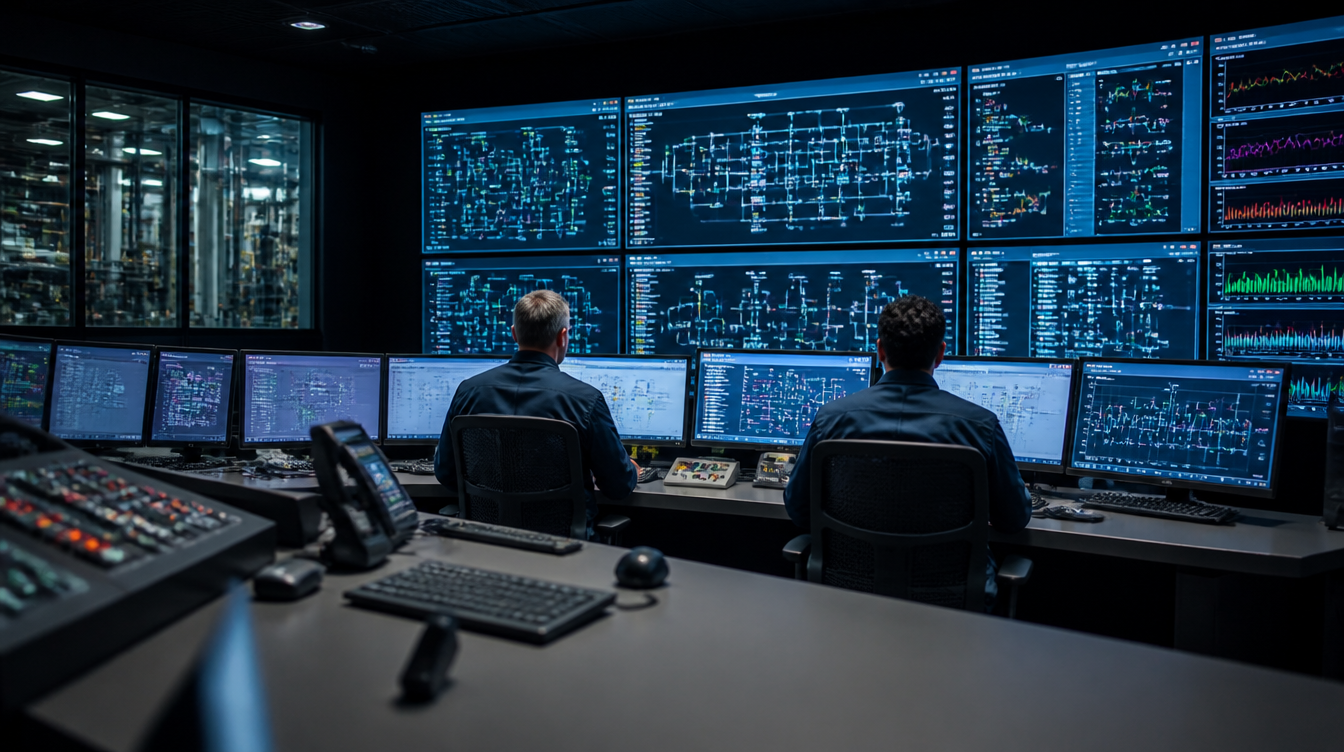
The evolution from traditional paper-based control rooms to AI-powered digital operations centers represents the most significant shift in maintenance management since CMMS adoption.

This transformation arrives at precisely the right moment, or perhaps just in time. You already know the demographic reality facing your organization: 69% of maintenance professionals are age 50 or older, and 40% of the manufacturing workforce will retire by 2030. The United States alone needs 3.8 million new manufacturing employees between 2024 and 2033, but current projections suggest 1.9 million of those positions will go unfilled. With 10,000 baby boomers retiring every single day, institutional knowledge is walking out the door at an alarming rate.

Here's the critical insight that should shape your strategy: AI is not primarily a job-elimination technology in maintenance. Instead, it may be the only viable strategy for sustaining industrial operations as decades of hard-won expertise disappears from the workforce. At Jeruel Global, we're working with maintenance leaders across industries who recognize that AI adoption isn't about replacing people, it's about augmenting human capabilities to do more with smaller, aging teams.

Understanding the Market Reality: Growth, Adoption, and ROI

The predictive maintenance market has exploded from roughly $10.6 billion in 2024 to a projected $47.8 billion by 2029, representing a 35.1% compound annual growth rate. The broader AI-in-manufacturing market is growing even faster, rocketing from $5.94 billion in 2024 toward an estimated $230 billion by 2034 at a stunning 44.2% annual growth rate. The CMMS/EAM market is on track to more than double from $1.4 billion to $3.8 billion by 2034 as AI features become table stakes for every platform.

The predictive maintenance market is experiencing explosive growth, with AI in manufacturing projected to reach $230 billion by 2034, representing a 44.2% compound annual growth rate.

But the adoption reality tells a more nuanced story than the breathless market forecasts suggest. While 77% of manufacturers report utilizing AI solutions broadly across their operations, maintenance-specific implementation significantly lags. The MaintainX 2025 State of Industrial Maintenance survey, which polled over 1,000 professionals, found that only 27% use predictive maintenance, actually down from 30% in 2024. Meanwhile, 71% still rely on preventive maintenance as their primary strategy, and 38% remain fundamentally reactive in their approach.

What's holding organizations back from realizing the benefits? Budget constraints top the list at 25%, followed closely by lack of expertise at 24% and cybersecurity concerns at 22%. McKinsey data reveals that 74% of companies struggle to scale value from AI initiatives, and over 70% of AI pilots never make it to production deployment. This isn't a technology problem, it's an implementation and change management challenge.

For those organizations that do successfully implement AI, however, the return on investment is extraordinary. McKinsey documents 10-40% maintenance cost reductions and up to 50% decreases in equipment downtime. Deloitte reports tenfold ROI from AI-driven predictive maintenance. Siemens found that predictive maintenance investments are typically recouped in just 3-6 months when deployed at scale. A Forrester Total Economic Impact study for Augury documented 310% ROI over three years with payback in under six months.

The message is clear: the winners in this transformation won't be determined by whether they adopt AI, but by how effectively they execute the implementation. This is why Jeruel Global has evolved our training programs to focus not just on reliability principles, but on leading teams through digital transformation while maintaining operational excellence.

How AI Will Transform Your Technician Workforce

The maintenance technician, whether mechanic, electrician, or instrumentation specialist, remains the backbone of every reliability organization. Today, these professionals spend their days receiving work orders, walking plant floors for inspections, troubleshooting breakdowns with multimeters and thermal cameras, referencing thick OEM manuals, and completing work orders with handwritten notes or basic CMMS entries.

AI tools flip the productivity equation for technicians, transforming time allocation from 90% searching to 60% actual repair work, a six-fold improvement in productive capacity.

Here's a statistic that should alarm you: an estimated 90% of maintenance time is spent looking for data and spare parts, with only 10% devoted to actual repair work. AI is about to flip that ratio, and this represents your single biggest opportunity for productivity improvement.

The Near-Term Reality (2025-2027)

AI is already arriving at technicians' fingertips through several practical applications. Samsara's AI Fault Code Severity system translates complex diagnostic trouble codes into plain-language descriptions with ranked severity levels and suggested repair steps, no more deciphering cryptic alphanumeric codes or hunting through manuals.

Augury's IoT sensors, already deployed at major facilities including PepsiCo, Colgate-Palmolive, DuPont, and Fiberon, listen to machines continuously and alert technicians to developing faults with what the company claims is 99.9%+ diagnostic accuracy. One PepsiCo maintenance lead described the technology simply as "the best thing in 27 years." This is the kind of tool that transforms how your technicians work, giving them superhuman hearing to detect problems weeks before traditional methods would catch them.

Augmented reality transforms how technicians work, providing hands-free access to step-by-step instructions, real-time sensor data, and 3D component visualizations while keeping both hands available for the actual repair.

Augmented reality represents another immediate game-changer for your team. PTC's Vuforia AR platform, running on Microsoft HoloLens 2, already overlays real-time sensor data and step-by-step repair instructions directly onto equipment at facilities like the UK's Materials Processing Institute steel plant. Fraunhofer FKIE demonstrated AR-guided maintenance for the Airbus A400M that reduced technician errors by 15%.

Voice AI is transforming how technicians document their work, and improving safety in the process. Industrial voice AI systems now achieve 96% transcription accuracy even in 100-decibel environments. This means your technicians can dictate work order updates hands-free while standing next to a running compressor. Plants deploying voice-to-CMMS workflows have trimmed administrative effort by 38% within six months. OSHA data from pilot programs shows a 43% drop in incident reports after deploying hands-free voice workflows, as technicians can focus on safety while documenting observations simultaneously.

The Longer-Term Evolution (2028-2031)

By 2028-2031, the technician's role evolves dramatically but does not disappear. Gartner projects that by 2028, 80% of frontline technicians will rely on voice AI daily. AI copilots will guide repairs step-by-step through AR overlays or earpiece-based assistants, functioning like having an expert mentor constantly available, which is exactly what you need as your most experienced technicians retire.

A Southeast Asian chemical producer equipped inspectors with vision-AI tablets and saw defect detection climb from 92% to 99%, shaving three days off a major turnaround and saving $1.2 million. This is the kind of ROI that gets executive attention and justifies continued investment in your team's development.

Boston Dynamics' Spot robot, with over 1,500 units deployed globally, and Gecko Robotics' wall-climbing inspection bots, which cut U.S. Navy inspection times by 90%, will handle routine data collection that once consumed valuable technician hours. Drones like Flyability's Elios 3 already let refineries inspect steam condensers in 8 hours instead of 8 days.

What Gets Automated vs. What Gets Augmented

Understanding this distinction is critical for your workforce planning and development strategy.

Tasks AI will automate completely:

  • Routine data collection rounds
  • Simple diagnostic triage
  • Work order generation from sensor alerts
  • Basic visual inspections
  • Route optimization

Tasks AI will augment, not replace:

  • Complex troubleshooting (AI provides ranked probable causes; the technician applies judgment)
  • Repair quality verification
  • Safety compliance and hazard assessment
  • Root cause analysis
  • Emergency decision-making under pressure
  • Equipment modification and custom fabrication

The job displacement risk for technicians is very low. The Bureau of Labor Statistics projects 15% growth in industrial machinery mechanic employment from 2023 to 2033, far outpacing average occupation growth. The labor shortage, not AI displacement, is the defining workforce challenge. As Fortune noted in January 2026: "AI won't hollow out the industrial workforce. Incorporating AI at scale to support a younger workforce may be the only way to sustain it."

The new skills your technicians will need include data literacy, AI tool proficiency, working alongside robots and drones, and cybersecurity awareness. Community college vocational enrollment increased 16% in 2025, signaling growing interest in these evolving careers. At Jeruel Global, we're adapting our Maintenance Technician Masterclass programs to incorporate these digital skills alongside fundamental craft knowledge.

How Planners Will Multiply Their Output 5-8X

Generative AI is revolutionizing maintenance planning productivity, enabling planners to produce 40+ detailed work plans per week compared to the traditional 5-8, representing a five to eight-fold increase in output.

Today's maintenance planner reviews work requests, develops detailed job plans, estimates labor and materials, and creates work packages, a process heavily dependent on tribal knowledge and manual data gathering. Industry benchmarks suggest effective planning can boost wrench time from the 35% norm to 55%, making 30 people as productive as 47. Yet most planners typically produce only 5-8 job plans per week, spending the majority of their time chasing data and responding to emergencies rather than creating detailed, reusable plans.

If you've struggled to justify adding planners to your team, or if your current planners are constantly firefighting instead of planning, generative AI is about to solve both problems.

The Productivity Revolution for Planning

Generative AI is completely rewriting the planning productivity equation. AIJobPlanner, a Canadian-developed tool demonstrated at recent industry events, generates detailed draft maintenance plans in under two minutes. Early users report productivity leaping from 5-8 plans per week to over 40, representing a five-to-eightfold improvement in output.

SAP's Maintenance Planner Agent, released in Q2 2025, continuously analyzes real-time data and suggests schedule adjustments, with SAP estimating up to 40% planner productivity gains. IBM's Maximo Application Suite 9.1 uses watsonx generative AI to auto-enrich work order data, recommend failure codes, and let planners query asset databases in plain English. MaintainX generates procedures directly from equipment manuals and provides real-time repair assistance through "CoPilot Suggestions."

McKinsey documented a consumer goods company whose generative AI copilot cut unscheduled downtime by up to 90%, reduced maintenance labor costs by a third, and gave technicians 40% more capacity. An oil and gas company used generative AI to automate FMEA generation for thousands of equipment items, a process that previously consumed weeks of engineering time per analysis.

The Evolution of the Planner Role

The planner's displacement risk is low, but the role transforms fundamentally. As James Reyes-Picknell, author of "Uptime," wrote in MRO Magazine: "If you are a planner, don't worry; AI won't take your job, it will make you better at it."

The planner evolves from plan writer to plan reviewer and optimizer, ensuring AI-generated drafts incorporate site-specific context, safety requirements, and quality standards that AI cannot fully grasp without human oversight. This is exactly the kind of strategic thinking we emphasize in Jeruel Global's maintenance planning courses: understanding the principles behind effective planning so you can evaluate and improve AI-generated outputs.

Organizations with large planning teams may maintain output while reducing headcount through attrition; smaller teams will handle vastly more work without growing their staffing levels. This creates an opportunity to get the planning coverage you've always needed without the budget increases you've struggled to justify.

Schedulers Gain Constraint-Aware Optimization

The maintenance scheduler balances competing demands: equipment availability, labor capacity, material lead times, production windows, and regulatory requirements. Today, this involves juggling spreadsheets, tribal knowledge about equipment interdependencies, and constant negotiation with operations.

AI-powered scheduling systems are transforming this intricate dance. These platforms can evaluate thousands of constraint scenarios simultaneously, something impossible for human schedulers regardless of experience level. They optimize not just for maximum equipment availability, but for factors like energy costs, production priorities, and even weather forecasts that might affect outdoor work.

Early implementations show schedulers can generate optimized weekly schedules in minutes rather than days, with better compliance to production windows and more realistic labor allocations. The scheduler's role shifts from puzzle-solving to exception management and strategic capacity planning.

This is particularly valuable for smaller organizations that may not have a dedicated scheduler. AI scheduling tools can enable a planner-scheduler to handle both roles effectively, or allow a maintenance supervisor to develop optimized schedules without specialized training.

Digital twins create virtual replicas of physical assets, enabling reliability engineers to see inside components, run failure simulations, and test maintenance scenarios without touching the actual equipment.

Reliability Engineers Become Strategic Orchestrators

Reliability engineers today analyze failure patterns, develop RCM strategies, calculate optimal PM intervals, and conduct root cause analyses. They are the strategic thinkers who determine what maintenance gets done and when, and their role is about to become exponentially more powerful.

AI is amplifying reliability engineering capabilities in ways that seemed impossible just a few years ago. Digital twins allow reliability engineers to simulate thousands of failure scenarios without waiting for real-world equipment to fail. Machine learning algorithms can identify subtle patterns in terabytes of sensor data that would take human analysts years to discover.

McKinsey found that generative AI helps reliability engineers complete failure mode and effects analyses in hours rather than weeks. One oil and gas company automated FMEA generation for thousands of equipment items, reclaiming weeks of engineering time per analysis that can now be redirected to higher-value strategic work.

The reliability engineer's role is expanding from reactive problem-solver to proactive system designer. They will spend less time on manual data analysis and more time on strategic decisions: What failure modes should we monitor? How should we balance predictive versus preventive strategies? Where should we invest in redundancy versus reliability improvement?

Job displacement risk remains low because the complexity of reliability engineering decisions still requires deep domain expertise and judgment. AI provides better data and faster analysis, but humans must interpret that data within the broader context of business objectives, risk tolerance, and operational constraints. This is why Jeruel Global's CMRP preparation and reliability engineering programs continue to emphasize fundamental principles, AI tools change how you apply those principles, but the underlying knowledge becomes more valuable, not less.

The Emergence of Remote Operations Centers

A new role is emerging that barely existed five years ago: the remote monitoring and diagnostics specialist working in centralized operations centers. These professionals oversee AI-monitored asset fleets across multiple facilities, triaging alerts and dispatching technicians based on AI-predicted failure probabilities.

Companies like Shell, Chevron, and major utilities have established remote operations centers where analysts monitor thousands of assets simultaneously. AI systems continuously analyze sensor data, flag anomalies, and rank them by criticality. Human analysts validate the alerts, consult with site teams, and coordinate responses.

This represents a fundamental shift from distributed monitoring at each facility to centralized expertise serving entire asset fleets. One analyst with AI tools can effectively oversee more equipment than entire teams could using traditional methods.

Maintenance managers orchestrate complex AI transformations across six key stakeholder groups, each with distinct concerns ranging from budget justification to workforce adoption to technical integration.

The skill set required combines data analysis, domain knowledge of specific equipment types, and excellent communication skills to collaborate with site teams who will execute the physical work. This role is growing rapidly and represents a career path for experienced technicians who prefer analytical work over hands-on repairs, an important consideration as your workforce ages.

What Maintenance Managers Must Do Differently

For maintenance managers and reliability leaders, the challenge of AI transformation is less technical than organizational. While AI can optimize schedules and predict failures, you must navigate change management, workforce development, budget justification, and cross-functional collaboration with operations, engineering, and IT.

The evidence is clear: technical AI deployment is the easy part. McKinsey found that 74% of companies struggle to scale value from AI, primarily due to organizational rather than technical barriers. BMW initially faced significant worker resistance to AI implementation, with concerns centered on job security. The company reduced resistance by 20% through early employee involvement and phased rollout rather than top-down mandates.

The Manager's New Responsibilities

Your role expands to include responsibilities that didn't exist previously:

AI vendor evaluation and management: Understanding which solutions actually deliver value versus marketing hype, evaluating proof-of-concept results critically, and managing vendor relationships to ensure they deliver on promises.

Data governance and quality oversight: Ensuring your CMMS data is clean enough for AI to learn from, establishing standards for data entry and maintenance, and championing data quality as a strategic priority rather than administrative burden.

Ethical AI deployment: Ensuring fairness and transparency in how AI recommendations are generated and applied, protecting worker privacy while using performance data to optimize workflows, and maintaining human accountability for AI-assisted decisions.

Integration management: Connecting AI systems to existing CMMS/EAM platforms, managing middleware and APIs that enable data flow, and ensuring different AI tools work together rather than creating new silos.

Workforce development leadership: Identifying skill gaps and training needs, building bridges between technology providers and frontline users, and championing continuous learning as AI capabilities evolve.

Leading Through Transformation

The managers who succeed in AI transformation share common approaches that you can adopt:

They involve frontline workers as partners rather than subjects, seeking input on which problems AI should solve and how tools should work in practice. They invest in training before technology deployment, ensuring teams understand both how to use new tools and why they're being introduced. They start with high-value use cases that build credibility, quick wins that demonstrate value and build momentum for larger initiatives. They maintain realistic timelines that allow for learning and adaptation rather than aggressive implementation schedules that create resistance.

The future maintenance technician builds AI collaboration skills on top of foundational craft expertise and digital integration capabilities, not replacing traditional knowledge but enhancing it with advanced tools.

Leadership skills become increasingly important relative to technical skills. The most effective managers communicate a compelling vision for how AI augments rather than replaces their teams, build bridges between technology providers and frontline users, and champion continuous learning as AI capabilities evolve.

This is exactly why Jeruel Global has evolved beyond technical training to offer programs that help managers lead their teams through digital transformation. Understanding AI technologies matters, but understanding how to bring your organization along on the journey matters more.

The Skills Revolution Your Organization Needs

The transformation of maintenance roles demands a parallel transformation in training and development. Traditional maintenance training focused on mechanical, electrical, and instrumentation skills. The AI era requires adding layers of digital competency without abandoning fundamental craft knowledge.

Community colleges are beginning to adapt. The Community College of Philadelphia now includes "Industry 4.0 & Digital Transformation" covering cyber-physical systems in their maintenance programs. Eurotraining has launched Vibration Analysis Category II with AI Competencies, the first formal integration of AI into a major condition monitoring certification.

The skills gap presents both challenge and opportunity. Deloitte projects that digital talent and skilled production roles are three times as difficult to fill as other manufacturing positions. Organizations that invest in developing their existing workforce rather than trying to hire AI-native talent from the outside are seeing better results.

At Jeruel Global, we're helping organizations bridge this gap by integrating AI literacy into our reliability and maintenance training programs. Our approach recognizes that your best technicians and engineers don't need to become data scientists, they need to understand enough about AI to use it effectively, question its recommendations intelligently, and identify opportunities for application in their daily work.

The Generational Dynamic

Interestingly, the generational dynamic isn't what many expect. McKinsey's research found that 62% of employees aged 35-44 report high AI expertise, compared with 50% of Gen Z and only 22% of baby boomers aged 65 and older. Millennial managers, not the youngest workers, are the most enthusiastic AI adopters and natural change champions within organizations.

This has important implications for your workforce development strategy. Your millennial supervisors and senior technicians may be your best champions for AI adoption, helping to bridge between senior leadership vision and frontline implementation.

Understanding the AI Technology Stack

Eleven distinct AI technology categories exist at different maturity levels, from early-stage generative AI and computer vision to mature predictive analytics and CMMS platforms, each requiring different implementation timelines and investment strategies.

The AI technology landscape for maintenance encompasses eleven major categories, each at different maturity levels. Understanding which technologies are ready for deployment versus still experimental helps you make smart investment decisions and avoid wasting budget on immature solutions.

Generative AI and Large Language Models (early-to-mid adoption) are proving most valuable for knowledge capture, cited by 39% of maintenance leaders as the number one use case, along with work order enrichment, procedure drafting, and FMEA generation. IBM Maximo's watsonx integration, ABB's Genix APM Copilot, and Siemens' Industrial Copilot lead commercial deployment.

Predictive Analytics and Machine Learning (mature) represent the largest market segment at $10.6 billion, with systems predicting failures 30-90 days in advance at 85-95% accuracy when properly calibrated. GE Vernova's SmartSignal library alone includes over 19,500 asset models across industries.

Computer Vision (mid-to-mature) achieves approximately 99% detection rates versus 80-90% for manual inspection. Boston Dynamics' Spot 5.0 introduced AI visual inspection via vision-language prompts in 2025. Baker Hughes' Waygate ADR uses convolutional neural networks for automated NDT defect recognition.

Digital Twins (mid-maturity, $2.25 billion market growing to $125.7 billion by 2030) enable real-time asset health monitoring and failure simulation. MathWorks has developed workflows that generate approximately 200 fault scenarios to train predictive algorithms without waiting for physical equipment failures.

Robotics and Autonomous Inspection ($6.7 billion market heading to $12.4 billion by 2030) includes Boston Dynamics Spot ($74,500-$150,000+), Gecko Robotics (valued at $1.25 billion), ANYbotics ANYmal (ATEX Zone 1 certified for hazardous environments), and Flyability Elios for confined spaces.

Edge AI and IoT process data at the machine level for sub-millisecond decisions. Vibration analysis represents 39.7% of edge AI implementations. Platforms like Litmus Edge connect to over 250 industrial protocols, making integration with legacy equipment more feasible than you might expect.

Five Barriers That Will Determine Your Success

Five critical barriers will govern how fast your organization can successfully transform through AI adoption. Understanding and addressing these proactively separates successful implementations from failed pilots.

The circular skills gap creates a critical barrier: maintenance teams lack the AI expertise to implement solutions, while data science teams lack the maintenance knowledge to optimize them, creating demand for rare hybrid talent that bridges both domains.

1. Data Quality: Your Foundation or Your Achilles Heel

Data quality remains the single greatest obstacle, cited by 70% of manufacturers as their primary challenge. Most CMMS databases contain years of inconsistent, incomplete, and unstructured work order data that AI cannot easily interpret. If your technicians enter "pump broken" as a work order description and "fixed it" as the completion note, AI has nothing meaningful to learn from.

You must invest significantly in data cleansing before AI can deliver meaningful value. This isn't glamorous work, but it's essential foundation-building. Start by standardizing equipment naming conventions, enforcing structured data entry for failure modes and causes, and retroactively enriching your most critical asset histories.

2. The Circular Skills Gap

The skills gap is circular and self-reinforcing: maintenance teams lack AI expertise, while data science teams lack maintenance domain knowledge. Finding professionals who understand both vibration analysis and machine learning algorithms is extraordinarily difficult.

You need to build these capabilities internally rather than hoping to hire your way out of the problem. This means training your best technicians and engineers in data literacy and AI fundamentals, while ensuring any data science support you bring in spends significant time learning your equipment and processes.

3. Legacy System Integration

Legacy system integration presents a practical bottleneck that's often underestimated in planning. The average age of industrial fixed assets is 24 years, the oldest in nearly seven decades. Connecting sensors and AI platforms to decades-old equipment and control systems requires significant middleware, customization, and often creative problem-solving.

The newest AI algorithm won't help if it can't communicate with your 1998-vintage PLC. Budget for integration expertise, plan for unexpected compatibility issues, and consider edge computing solutions that can work with older protocols.

4. Change Management: The Most Common Failure Point

Change management failures derail technically sound deployments more often than technical issues. BMW's experience is instructive: they initially faced significant resistance from workers concerned about job security. The company reduced resistance by 20% through early employee involvement and phased rollout rather than big-bang implementation.

The lesson is consistent across successful deployments: involve frontline workers as partners in AI deployment, not subjects of it. Listen to their concerns, incorporate their expertise into implementation decisions, and give them agency in how tools get used rather than mandating workflows from above.

5. Cost Justification for Smaller Organizations

Cost justification remains challenging for smaller organizations. While Fortune 500 companies can absorb six-figure pilot project costs, smaller manufacturers struggle. Forty-seven percent of companies with fewer than 200 employees reported low CMMS platform utilization within the first six months, suggesting smaller firms need more turnkey, affordable AI solutions rather than enterprise-scale implementations.

If you're leading a smaller organization, look for AI features embedded in your existing CMMS platform rather than standalone solutions, start with free or low-cost pilot programs from vendors, focus on quick-payback use cases like automated work order enrichment, and leverage vendor professional services to accelerate implementation rather than building expertise entirely in-house.

Your Action Plan: From Understanding to Implementation

By 2031, many organizations will adopt centralized AI-enabled operations centers monitoring multiple facilities, with smaller on-site teams equipped with AR tools, autonomous inspection systems, and real-time guidance from remote experts.

The transformation of maintenance and reliability by AI is not a future scenario to prepare for, it's underway right now. The evidence overwhelmingly shows that AI augments rather than replaces maintenance roles. Every position examined faces significant evolution in responsibilities, tools, and required skills, but none faces wholesale elimination.

Three strategic insights should shape your approach:

First, generative AI for knowledge capture and work order intelligence is your near-term priority, more immediately impactful over the next two years than predictive analytics, which requires substantial infrastructure investment. The 39% of maintenance leaders identifying knowledge capture as AI's top use case recognize that the retirement crisis makes this existentially urgent. When 10,000 baby boomers retire every day, capturing their expertise before they walk out the door isn't optional.

Second, invest in people alongside technology. McKinsey's research on frontline talent shows that companies building worker capabilities before implementing AI see dramatically better returns on investment. Technology deployment without workforce development creates expensive shelfware that generates reports nobody reads and recommendations nobody follows.

Third, prepare for structural organizational change. The maintenance organization of 2031 will be structurally different: flatter hierarchies, more centralized monitoring, and more distributed execution. Remote operations centers will oversee AI-monitored asset fleets across multiple facilities, while smaller, highly skilled on-site teams handle physical interventions guided by AI copilots. The traditional model of large maintenance crews at each facility is giving way to centralized expertise supporting distributed assets.

Your 12-Month Roadmap

Here's a practical roadmap for maintenance and reliability leaders ready to lead this transformation:

Months 1-3: Assessment and Foundation

  • Audit your CMMS data quality and identify critical gaps
  • Survey your team on AI readiness and concerns
  • Identify 2-3 high-value use cases for initial pilots
  • Begin data cleansing for critical asset classes

Months 4-6: Pilot and Learn

  • Launch limited pilots with engaged early adopters
  • Partner with vendors on proof-of-concept programs
  • Invest in foundational AI literacy training for supervisors
  • Document lessons learned and quick wins

Months 7-9: Scale and Integrate

  • Expand successful pilots to broader deployment
  • Integrate AI tools with existing CMMS workflows
  • Develop standard operating procedures for AI-assisted work
  • Create metrics to track adoption and value realization

Months 10-12: Optimize and Expand

  • Refine AI models based on operational feedback
  • Address resistance and adoption barriers proactively
  • Launch additional use cases building on initial success
  • Develop long-term workforce development plan

The window for competitive advantage is narrow. With 65% of maintenance teams planning AI adoption by the end of 2026, the difference between industry leaders and laggards will be defined not by whether they adopt AI, but by how effectively they integrate it into every role, workflow, and decision across their reliability organizations.

How Jeruel Global Is Helping Leaders Navigate This Transformation

At Jeruel Global, we recognize that technical knowledge alone isn't enough to lead your organization through this transformation. That's why we've evolved our training programs to address both the technical fundamentals and the leadership skills required to implement AI successfully.

Our CMRP Certification Preparation programs now include modules on AI-augmented reliability decision-making, helping you understand how to evaluate AI recommendations against fundamental reliability principles. Our Maintenance Planning and Scheduling courses incorporate generative AI tools for plan development while teaching you to review and optimize AI-generated outputs. Our Maintenance Management programs focus heavily on change leadership, helping you navigate the organizational challenges that derail most AI implementations.

Most importantly, we're helping maintenance and reliability professionals understand that AI doesn't diminish the value of deep expertise, it amplifies it. The professionals who will thrive in this AI-augmented future are those who combine strong fundamental knowledge with the ability to leverage AI tools effectively. That's exactly the combination our programs are designed to develop.

The organizations achieving the highest AI ROI are those that invest in people alongside technology. If you're serious about leading rather than following this transformation, investing in your team's development isn't optional, it's the foundation of success.

Conclusion: The Choice Is Yours, But the Timeline Isn't

AI won't replace your maintenance team, but maintenance teams that effectively use AI will replace those that don't. The transformation is here. The question is not whether to embrace it, but how quickly and how well you can execute the integration.

The industrial world has weathered technological transformations before, from the introduction of programmable logic controllers to computerized maintenance management systems. Each time, the predictions of massive job displacement proved wrong. Humans adapted, learned new skills, and found ways to create more value with better tools.

This AI transformation will follow the same pattern, but with one critical difference: the timeline is compressed. The pace of change is faster, the competitive stakes are higher, and the workforce challenges are more acute than in previous transitions. Organizations that recognize AI as a strategic imperative for workforce sustainability rather than primarily a cost-cutting technology will be best positioned to thrive in the decade ahead.

Your competitors are moving now. The maintenance leaders who successfully navigate this transformation will be those who act decisively, investing in data quality, workforce development, and change management alongside technology. Those who wait for perfect clarity or fully proven solutions will find themselves struggling to catch up as their competitors pull ahead and their most experienced workers retire.

The next 12-24 months will define your organization's trajectory for the next decade. Make them count.

About Jeruel Global: Jeruel Global provides world-class training in maintenance and reliability, helping organizations develop the technical expertise and leadership capabilities needed to excel in an increasingly digital industrial environment. Our programs combine fundamental reliability principles with practical guidance on leveraging emerging technologies to achieve operational excellence. Contact us to discuss how we can support your team's development.

Ready to elevate your skills or empower your team?