Maintenance Backlog Management: How to Read Yours and What to Do About It
Four hundred open jobs could mean a healthy plant or one that has given up closing anything. The size tells you little. Sort by age and the picture changes completely.

Somebody asks how big your backlog is. You say four hundred jobs. They wince, and the conversation moves on to how you are going to get it down.
That conversation is mostly useless, because the number on its own says almost nothing. Four hundred jobs could be a healthy plant with a well fed schedule or a plant that has given up closing anything.
The useful question is not how many. It is how old.
What the age of a job tells you
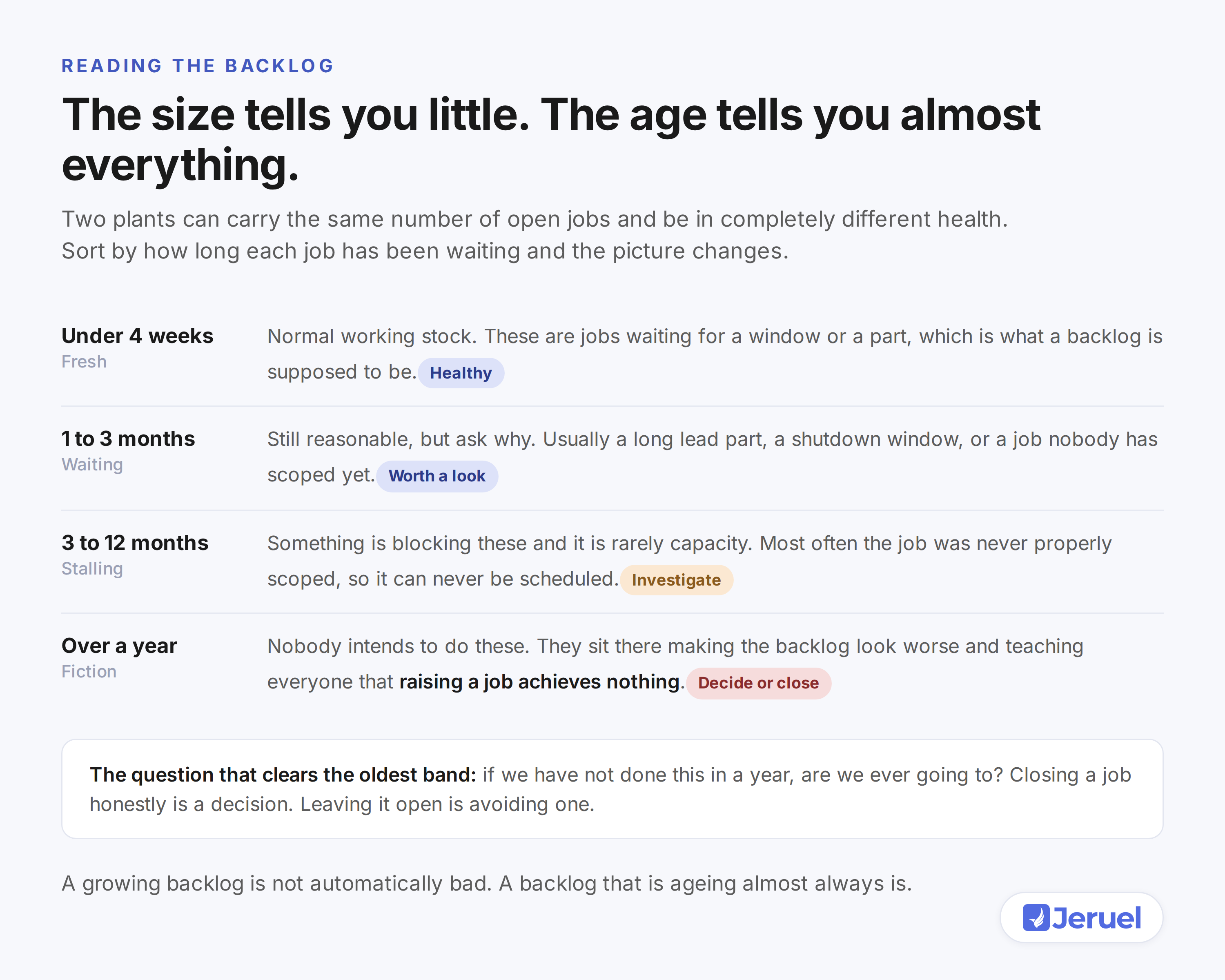
Sort your open jobs by how long they have been sitting and you get a picture the total never gives you.
The recent band is your working stock. Jobs waiting for a window, a part or a slot. You want this to be reasonably full, because it is what the scheduler draws from.
The middle band is where questions start. Something is holding these up, and it is worth knowing what.
The oldest band is the honest one. Jobs sitting for more than a year are not waiting. They are being avoided, and everyone knows it.
Why old jobs are worse than they look
The obvious cost is that the work is not done. There are two less obvious ones that matter more.
The first is that they hide the real backlog. When a quarter of your list is fiction, nobody can tell what actually needs doing, so the list stops being used for planning at all.
The second is what they teach people. A technician who raises a job and watches it sit for eighteen months learns that raising jobs achieves nothing. After that they stop raising them, and you lose the early warnings that made the system worth having.
That second cost is the one that really hurts, because it is invisible and it is very hard to undo.
The question that clears the oldest band
For every job older than a year, ask one thing. If we have not done this in a year, are we ever going to?
Sometimes the answer is yes, and it needs a real date and a real owner. Sometimes the answer is that the equipment has changed, the problem went away, or it was never important. Then close it and say why.
Closing a job honestly is a decision. Leaving it open is avoiding one.
Plants often worry this looks like cheating the numbers. It is the opposite. A backlog you have deliberately cleaned is a backlog you can trust, and trusting it is the whole point.
Look at what is stuck, not just how long
Once the fiction is gone, the middle band becomes readable, and it usually tells you something specific.
Group the stuck jobs by why they are stuck. Waiting for parts. Waiting for a shutdown. Never scoped. Needs a specialist. No budget.
Most plants find one or two reasons dominate. If half your stuck jobs are waiting on a shutdown window, your problem is window access, not maintenance capacity. If half were never scoped, your problem is planning time.
Those are different problems with different fixes, and the total backlog number obscures both of them.
Separate the ready pile
One distinction is worth making permanently.
Ready backlog is work that is planned and could run tomorrow if you had the hours. Total backlog is everything anyone has ever raised.
Scheduling draws from the ready pile. Its size is what tells you whether next week can be filled with useful work. Most plants want a few weeks of it, so there is always something prepared to pull forward when production offers an unexpected window.
Reporting one number that mixes the two makes both unreadable.
Watch the direction, not the level
A backlog that grows for a month means little. The trend over six months means a lot.
Steady is fine. It means you are completing roughly what you raise, which is what a stable plant looks like.
Growing steadily means you are raising more than you can do. That is a capacity conversation, and now you have the evidence for it.
Falling fast is worth checking rather than celebrating. Sometimes it means good work. Sometimes it means people have stopped raising jobs, or somebody has been closing things to make a chart look better.
A first pass you can do this week
Export your open jobs with their raised dates. Sort by age. Count how many fall into each band.
Take the oldest band to your next maintenance meeting and go through it with the one question above. Most plants clear a surprising number in an hour, because for many of them everyone in the room already knows the honest answer.
What is left is a list you can actually work with. It will look smaller, and for the first time it will be true.