Maintenance Improvement Programmes: How to Keep One Alive Past Month Four
Most improvement efforts do not fail at the start. They fade around the fourth month, when the launch energy has gone and the new way of working has not yet become habit. Here is what happens in that stretch, and the practical things that carry a programme across it.

Most maintenance improvement efforts do not fail at the start. They fail quietly, somewhere around the fourth month, and nobody announces it.
You will probably recognise the shape of it. The kick-off goes well. The first weeks produce real wins, because the obvious problems were sitting there waiting. Then a shutdown swallows a fortnight. A meeting gets skipped and nobody reschedules it. Two months later someone asks whether the programme is still running, and the honest answer is no.
This is not a failure of will, and it is rarely a failure of the idea. It is a predictable stage that almost every effort passes through. So it is worth understanding what happens at month four, and what you can put in place beforehand to carry you across it.
Why the fourth month is the dangerous one
Three things tend to arrive at the same time.
The launch energy is spent. Attention is a resource like any other, and the supply that came from the announcement runs out after about a quarter.
The easy wins are finished. What remains needs other departments, longer timescales, and decisions that are not yours to make.
And the first genuinely bad week turns up. A major failure, a staff shortage, a rush order. The improvement work now has to compete for the same people, and it loses, because the breakdown is today and the improvement is next year.
Underneath all three is a simple mismatch worth seeing clearly.
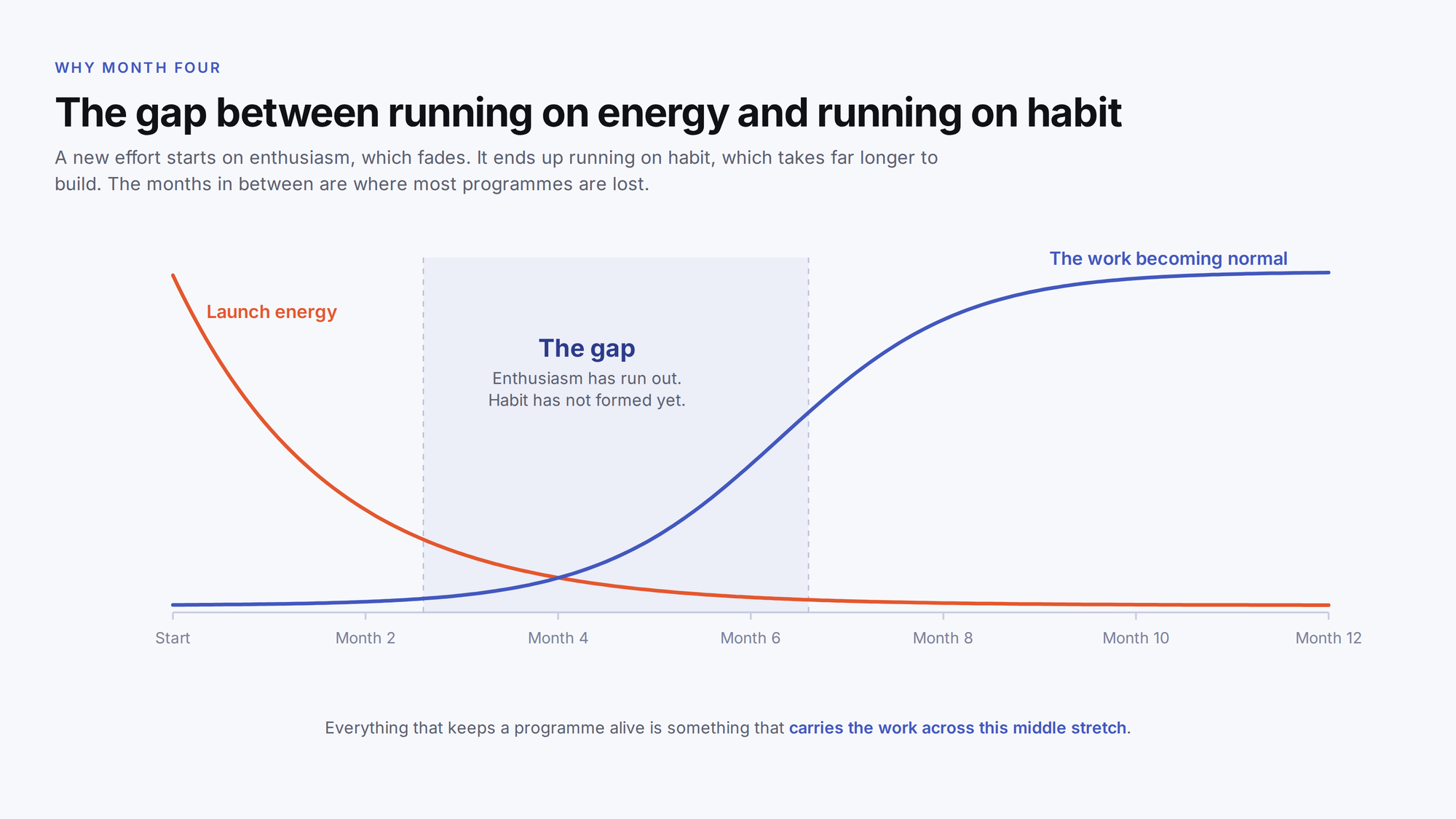
A new effort starts out running on enthusiasm. It ends up running on habit, which is far more durable. The trouble is that enthusiasm fades much faster than habit forms, so the two do not overlap. Everything useful you can do here is a way of carrying the work across that middle stretch.
Call it a way of working rather than a programme
Programmes have launch dates, and anything with a launch date is assumed to have an end date. Some of your crew will simply wait it out, and they will often be right to.
Think about what a long serving technician has already lived through. Planned maintenance, then predictive, then a total productive maintenance push, then reliability centred maintenance, each with a new name and a new manager. If most of those faded, the sensible response to a new banner is patience rather than effort.
You can sidestep a lot of that. Skip the branded name and the launch event. Describe what you are doing in the language of the work instead. We are going to write better job plans. We are going to close out work orders properly. Those sentences have no end date built into them, so nobody has to wait for one.
Put the work inside somebody's normal week
Improvement work that sits on top of a full week is always the first thing dropped. That is not a discipline problem. It is arithmetic.
So give it a home in the week that already exists. Add ten minutes to the weekly scheduling meeting rather than creating a new meeting. Name the work in somebody's role, not in a project charter. If a reliability engineer owns it, protect a block of their time and mean it.
That last one matters more than it sounds. In many plants the reliability engineer is the most convenient spare pair of hands, so they get pulled onto the failure of the day every week. Their improvement work then slips indefinitely, and the reason is invisible in any report you look at.
Do fewer things, and finish them
A great deal of improvement advice is sequenced as though you had a spare team. Criticality analysis on every asset first, then asset strategies, then storeroom processes. On a site with tens of thousands of tagged assets, step one alone can absorb a year and produce nothing anyone can see.
Aim instead for one finished thing per quarter. Not one started thing.
Finished means it is in use without you standing over it. Failure codes rewritten and being used correctly. Job plans done for the top twenty jobs. Close out text that a stranger could learn something from. Each of those is small enough to complete and visible enough to be believed.
Three half finished large changes leave nothing behind. One completed small change leaves a foothold, and the next one starts from higher ground.
Keep one short meeting with someone who can unblock things
The single most useful piece of structure is a short standing review with a site leader in the room.
Half an hour a month is enough. It is not a status report, and slides are not needed. Two questions do the work. What moved since last time, and what is stuck.
The second question is the point. Most stalled improvement work is not stuck on effort. It is stuck on a decision someone else has to make, a budget line, or another department's agreement. Those things can sit for months in an email queue and clear in ninety seconds in a room.
Having a leader present does something else too. It signals that the work is still counted, which is exactly the signal that goes missing in month four.
Tell the story as well as the number
Reliability numbers move slowly. In month four you may have nothing convincing to show, which is awkward if numbers are all you promised.
So collect the moments as well. The bearing that was caught on a route before it failed. The Saturday job that finished early because the parts were kitted. The pump that has not come back this year.
Say those out loud, in the shift meeting, with the name of whoever did the work. It costs nothing and it does two things. People see that the work is noticed, and they get a picture of what good looks like that no metric conveys.
Keep gathering the numbers quietly in the background. When they finally arrive, they land on an audience that is already paying attention.
Plan the handover before you need it
Managers move. If your improvement effort lives in one person's head and enthusiasm, it ends with their promotion, and that is a genuinely common way for good work to disappear.
The protection is unglamorous and takes an afternoon. Write down what you do, who does it, and when. Two pages, in plain language, kept where people can find it.
Two pages is something a successor can pick up. A charismatic champion is not.
If yours has already stopped
Plenty of readers will be looking back at something that faded last year. Restarting is very doable, with one condition.
Say plainly what happened to the last attempt. People are rarely cynical about improvement itself. They are cynical about being asked again as though the previous ask never happened. A sentence acknowledging it buys more goodwill than any launch presentation.
Then start smaller than feels satisfying. Find whatever survived, because something usually did, and build the restart around that.
The short version
Month four is not a verdict on your idea. It is the ordinary point where the energy that started things runs out, before the new way of working has had time to become normal.
Almost everything in this article does the same job. Keep the work small, keep it inside the week, keep one person with authority interested, and keep telling people what is changing.
Do that and month four stops being where programmes go to die. It becomes a stretch of road you already knew was coming.