Maintenance Improvement Programmes: How to Keep One Alive Past Month Four
Most improvement programmes do not fail. They go quiet around month four, when the effort is real and the results are not visible yet. Here is how to get a team across that gap.

Nearly every maintenance improvement starts well. There is a kick off meeting, a plan on a wall, and a group of people who genuinely want it to work.
Then somewhere around the fourth month it goes quiet. The weekly review gets moved because of a breakdown. The next one gets skipped. Two months later somebody asks what happened to it, and nobody can quite say.
Nothing failed exactly. It just stopped. If you have watched that happen once or twice, this is about how to make the next one hold.
The shape of the problem
Improvement work has an awkward shape. The effort is steady from day one, but the results are not. They arrive late, and they arrive quietly.
That leaves a gap of two or three months where your team is doing extra work and has nothing to show for it. The gap is not a sign that something is wrong. It is simply how prevention works, because the thing you are producing is failures that do not happen, and nobody notices those.
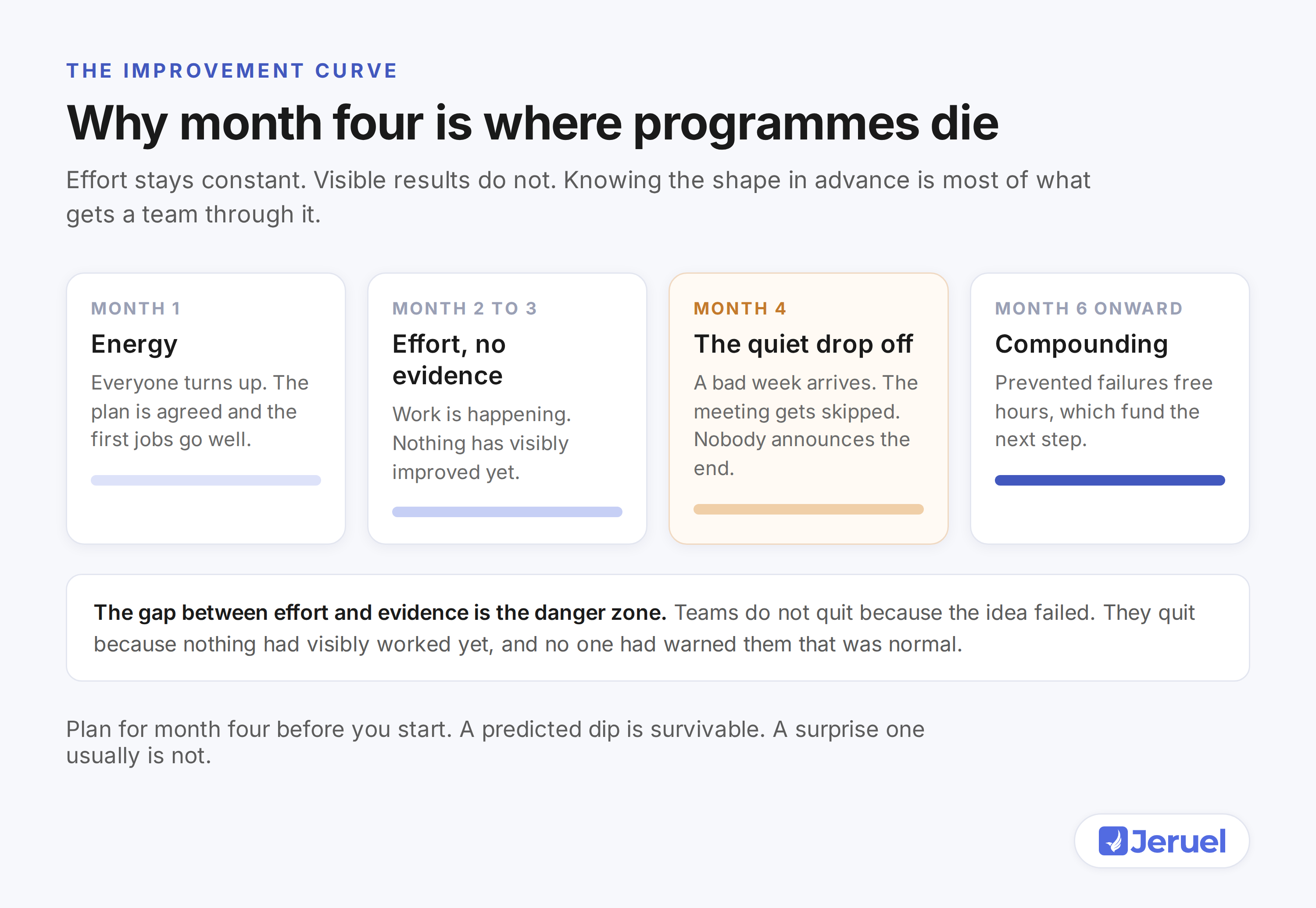
Understanding this changes what you do at the start. Most programmes die in that gap, so the whole job is getting a team across it with their belief intact.
Say the dip is coming, before it comes
This is the single most useful thing you can do, and it costs nothing.
At the kick off, tell everyone plainly that around month three or four it will feel like this is not working. Say that the extra effort will be real and the results will not be visible yet. Say that this is the normal shape, not a warning sign.
When people are told to expect a hard patch, they treat it as a stage. When they are not, they treat it as evidence. That is the whole difference, and it is decided in the first meeting.
Pick something small enough to finish
Ambition is what usually sinks these efforts. A plan that touches planning, stores, condition monitoring and training all at once needs constant attention from several people who do not have it to give.
Choose one thing instead. One asset, one process, one crew. Something you can finish inside a quarter and point at.
A finished small thing does something a half finished big thing never does. It gives you proof. And proof is what buys you permission to do the next one.
Give it a named owner and a standing time
Anything that belongs to everybody belongs to nobody. Put one name against it, and make sure that person has the authority to change something rather than just report on it.
Then give it a fixed slot in the week. Same day, same time, thirty minutes. The slot matters more than its length, because a meeting with a permanent home survives a bad week and a floating one does not.
Watch that slot carefully in months three and four. When it starts moving, the programme is already in trouble, and that is your earliest warning.
Show progress with something other than results
If the only measure is fewer failures, you have nothing to show for a quarter.
So measure the work as well as the outcome. How many job plans were written. How many hours were protected. How many failure records got a proper cause this month.
These are activity measures, and on their own they can mislead. Paired with the outcomes, they are exactly what you need during the gap, because they let a team see movement while the real results are still forming.
Watch for the four quiet signs
Programmes rarely announce that they are ending. They give off signals first, and all four are easy to spot if you are looking.
The review meeting starts getting moved. Actions carry over unchanged for three weeks in a row. The person who owns it stops being asked about it. And the language shifts from what we are doing to what we tried.
Any one of those is worth a conversation that week, not next month. Once a programme has been quiet for a full month, restarting it is much harder than keeping it alive would have been.
Make the first win visible
Somewhere in month four or five you will get your first clear result. A machine that used to fail every six weeks goes three months. A job that always ran over comes in on time.
Do not let that pass without comment. Tell the crew what happened, in specific terms, and name what caused it. Not a general note about improvement, but the actual chain: this inspection found this fault, so this breakdown did not happen.
People will work through a hard patch for a while on trust. After that they need evidence, and this is it.
Then do the next small thing
When the first piece is finished and proven, resist the urge to scale it everywhere at once. Pick the next small thing. Use the same owner, the same slot, the same rhythm.
This is slower than a plant wide programme, and it is far more likely to still be running next year. Ten small finished things beat one ambitious plan that stalled in month four, and the plants that improve steadily are almost always doing the former.
None of this requires a new system or a budget. It requires choosing something small, protecting a slot in the week, and warning people about month four before they get there.