Maintenance Job Plans: How to Write One a Technician Will Be Glad to Get
Ask your crew what they do with your job plans. If they glance at the parts list and work out the rest themselves, the plans are written for the file rather than the person doing the job.

Here is a quick way to find out whether your job plans are any good. Walk out to the crew and ask what they do with them.
If the honest answer is that they glance at the parts list and work out the rest themselves, you have your answer. The plans are being written for the filing system, not for the person holding the spanner.
That is not a criticism of the planner. It is usually a symptom of writing plans from a desk without knowing what the technician will actually run into.
The same job, written two ways
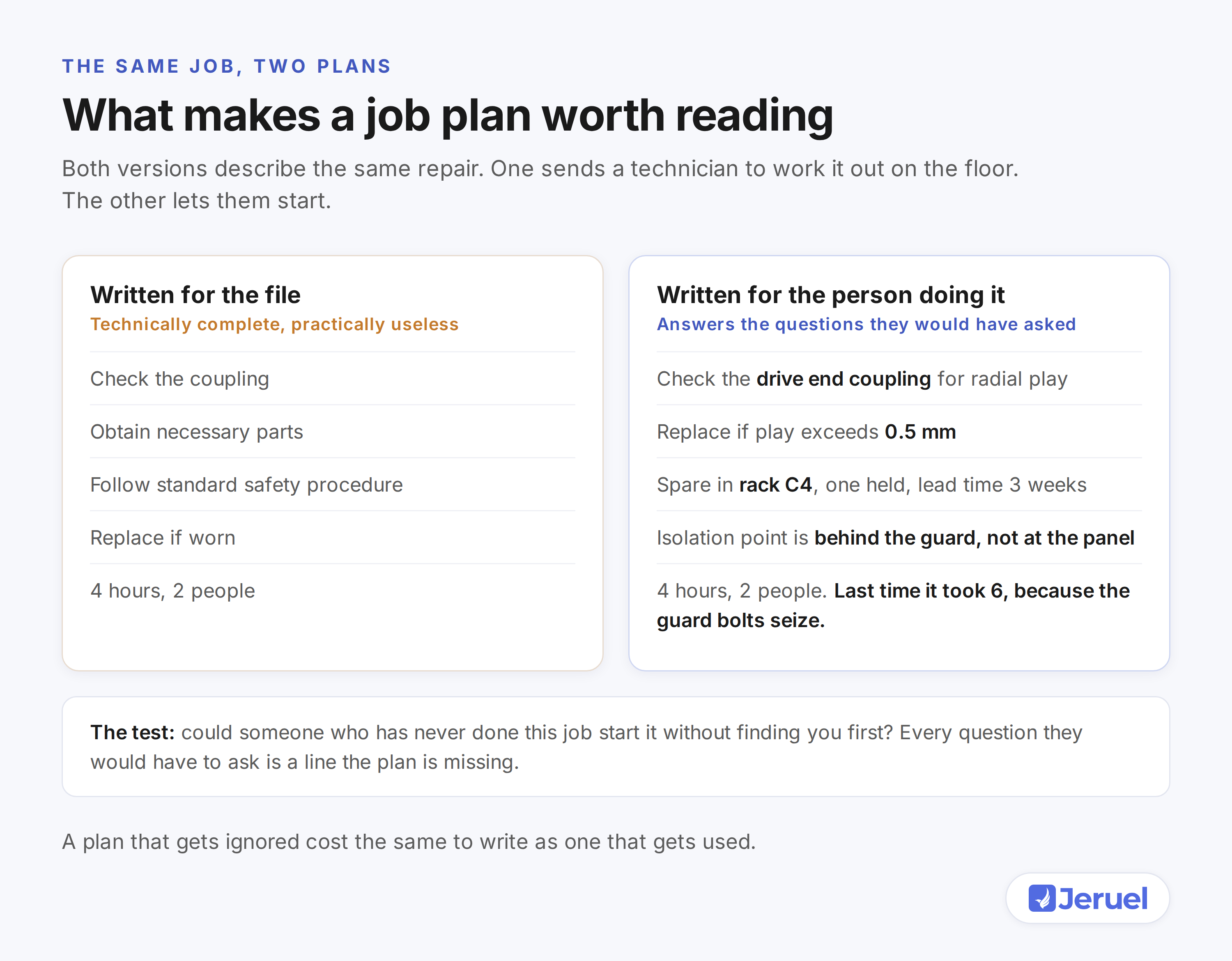
Look at the left column. Nothing there is wrong. It is a legitimate job plan and it would pass an audit.
It is also useless at the machine. Which coupling. Worn by how much. Where is the spare. And the technician who has done this job before knows the guard bolts seize, which is the single most useful fact about it and appears nowhere.
The test that fixes most plans
Before you release a plan, ask one question. Could someone who has never done this job start it without coming to find me?
Every question they would have to ask you is a line the plan is missing.
This test works because it moves the plan from a description of the work to a set of answers. And answers are what a technician standing at a machine at seven in the morning actually needs.
Be specific where it matters
Not every line needs detail. The ones that decide something do.
Say which component, not the category. Drive end coupling, not the coupling.
Give the limit, not the judgement. Replace if play exceeds half a millimetre, not replace if worn. Otherwise two technicians will make two different calls, and both will believe they followed the plan.
Say where the part is and whether you have it. A part number is useful. A part number, a location and a note that there is one on the shelf is much more useful.
Say where the isolation point is if it is not obvious. This is a safety line, and it is also the kind of thing that costs twenty minutes of hunting.
Put the awkward bits in
This is the part that separates a plan written from records from a plan written with the crew.
Every recurring job has friction that never appears in the manual. Bolts that seize. A cover you cannot lift alone. A fitting that only comes off with a particular tool. Access that requires a platform somebody has to book.
Those details are why the four hour job takes six. Put them in the plan, and the estimate stops being fiction. Leave them out, and the crew learns to ignore your estimates.
You get these details by asking the technicians who did it last time. Twenty minutes with two people will improve a plan more than an afternoon of desk work.
Be honest about the hours
An estimate that is always wrong in the same direction stops being an estimate.
If the same job has run over on the last three occasions, the plan should say so and say why. Four hours if the guard comes off cleanly, six if the bolts are seized, which is what happened the last two times.
That reads as less confident than a flat four hours. It is far more useful, because the scheduler can now plan for the realistic case rather than the hopeful one.
Keep it short enough to read
The opposite failure is real too. Some plans run to eight pages because everything anyone thought of got added.
Nobody reads eight pages at a machine. They read the first page and skim the rest, which means important lines get missed in the noise.
A useful shape for most jobs is one page. What you are doing and why. Parts and where they are. The steps that matter, including the awkward ones. Safety points specific to this job. What to record when you finish.
Standard safety instructions that appear on every plan in the plant are noise on this page. People stop reading things they have read four hundred times.
Close the loop
The best source of improvement for a plan is the last time it was used.
When the job comes back, look at what the technician wrote. If they found something the plan did not mention, add it. If a step was wrong, correct it. If the hours were out, adjust them.
A plan that gets updated after every use becomes genuinely good after three or four cycles. A plan written once and filed stays exactly as accurate as the day it was written, which is usually not very.
Where to start
Pick the job your plant does most often. Not the biggest one, the most repeated one, because that is where the return multiplies.
Take the current plan to the two technicians who do it. Ask what is missing, what is wrong and what they always have to work out themselves. Rewrite it that afternoon.
Then watch the next time it runs. You will usually see the difference in the hours, and you will certainly hear about it from the crew.