Maintenance Planner Productivity: What Fills the Week and How to Win Time Back
Six in ten maintenance leaders say their planners spend less than a third of their time planning. The rest goes somewhere specific, and most of it is fixable.

Ask a maintenance planner what they did today and you will often get a slightly rueful answer. Chased a part. Sat in two meetings. Went out to the line because number four went down and nobody could find the drawing.
Somewhere in there, maybe an hour of actual planning.
This is not a rare problem. In one survey of maintenance leaders, six in ten said their planners spend less than a third of their time planning. If that matches your plant, the useful question is where the rest goes, because the answer points at fixes that are easier than they look.
Where the week actually goes
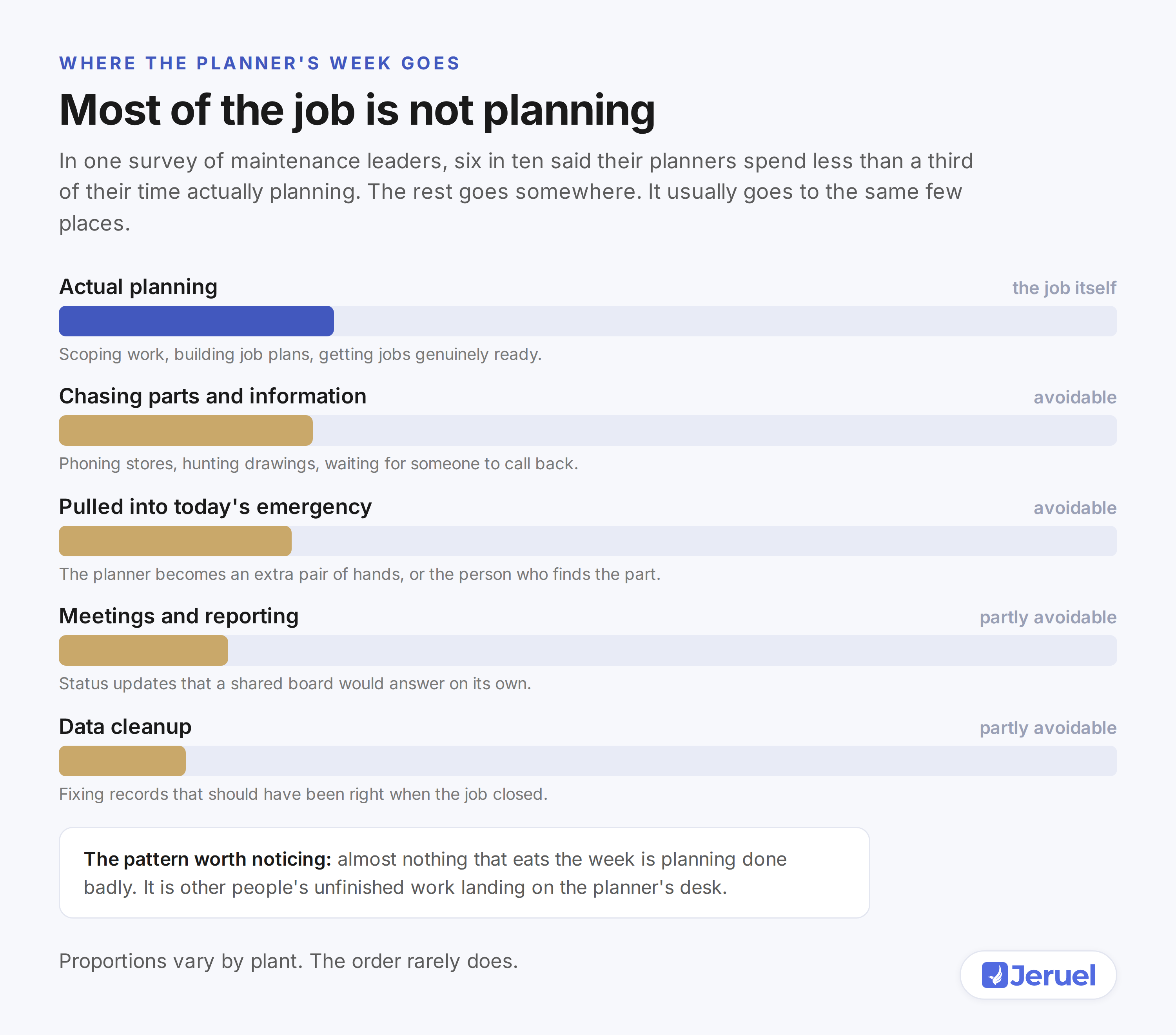
Look at that list and notice something. Almost none of it is planning done badly. It is other people's unfinished work arriving on the planner's desk.
The part was not where the system said it was. The drawing was never filed. The job that closed last month did not say what was found, so somebody has to work it out again. Each of these is small. Together they are most of a week.
The emergency pull is the big one
When a machine goes down, the planner is often the most useful person in the building. They know where things are, who to call, what was done last time.
So they get pulled in. And it feels right, because they genuinely help.
The cost is invisible and large. Every hour a planner spends on today's emergency is an hour not spent preparing next week's work. Next week's work then runs badly, because it was not prepared. That produces more emergencies, and the planner gets pulled in again.
Breaking this is mostly a decision by their manager, not by the planner. Somebody has to say plainly that the planner is not the emergency response resource, and then hold that line on a bad day.
If the plant genuinely cannot cope without them, that is worth knowing too. It usually means the crew lacks information the planner is holding in their head, which is a different problem with a different fix.
Kill the chasing, one cause at a time
Chasing parts and information is the most fixable item on the list, because each instance has a specific cause.
Keep a simple tally for two weeks. Every time you chase something, write one line. What you were chasing and why it was not there.
You will find the same few causes over and over. Stock records that do not match the shelf. Drawings that live on somebody's local drive. A supplier who never confirms lead times. Three or four causes usually explain most of the chasing.
None of those are planning problems, and none of them get fixed by the planner working harder. They get fixed by naming them and handing them to whoever owns that process, which is a conversation the tally makes easy.
Plan fewer jobs, properly
Under pressure, most planners spread themselves thin. Fifty jobs get a light touch instead of fifteen getting proper preparation.
That is the wrong trade, and it is worth being direct about why.
A properly planned job has the parts staged, the tools identified, the procedure checked and the access agreed. It runs in a fraction of the time of the same job unprepared, because most delay in maintenance is waiting rather than working. A lightly planned job is barely better than no plan at all, because the crew still has to work it out on the floor.
So fifteen jobs done well save more hours than fifty done thinly. And those saved hours are what create room to plan the next twenty properly.
Write the plan for the person doing the job
A job plan that gets ignored cost the same to write as one that gets used.
The difference is usually specificity. Not "check the coupling" but which coupling, what you are looking for, what the acceptable limit is, and what to do if it is out. Not "obtain parts" but the part numbers and where they are.
The fastest way to improve this is to ask the technicians. Take three recent plans to the crew and ask what was missing and what was noise. You will get a short, blunt, extremely useful list.
Make what you know available
A lot of a planner's time goes on being the plant's search engine. Where is that drawing, what did we do last time, who worked on this before.
Every one of those questions is a sign that something is not findable. When you answer one, spend two minutes putting the answer where the next person will look. The drawing in the shared folder. The note on the asset record. The lesson in the job plan.
This feels like extra work in a week that has none spare. It is the only version of this that compounds, because each answer filed is a question that never comes back.
What to do first
If you only change one thing, run the chasing tally for two weeks. It is nearly free and takes a minute a day. It turns a vague sense of being busy into three specific causes you can put in front of someone.
If you can change two things, add a protected block. Half a day a week where the planner plans and is not available for anything short of a genuine emergency.
Neither of these needs software or a budget. They need someone to accept that a planner pulled onto the floor every afternoon is not really a planner. Then they need to defend the alternative long enough to see it work.