Maintenance Planning vs Scheduling: What Each Role Actually Does
Planning answers what and how. Scheduling answers when and who. When one person does both under pressure, scheduling always wins and the planning quietly disappears.

In a lot of plants, one person is called the planner and does both jobs. They work out what a job needs, and they also decide when it runs. On paper that looks efficient.
In practice it is why neither job gets done properly. The two need different time horizons, and one of them will always win.
The simplest way to hold them apart
Planning answers what needs doing and how. Scheduling answers when it runs and who does it.
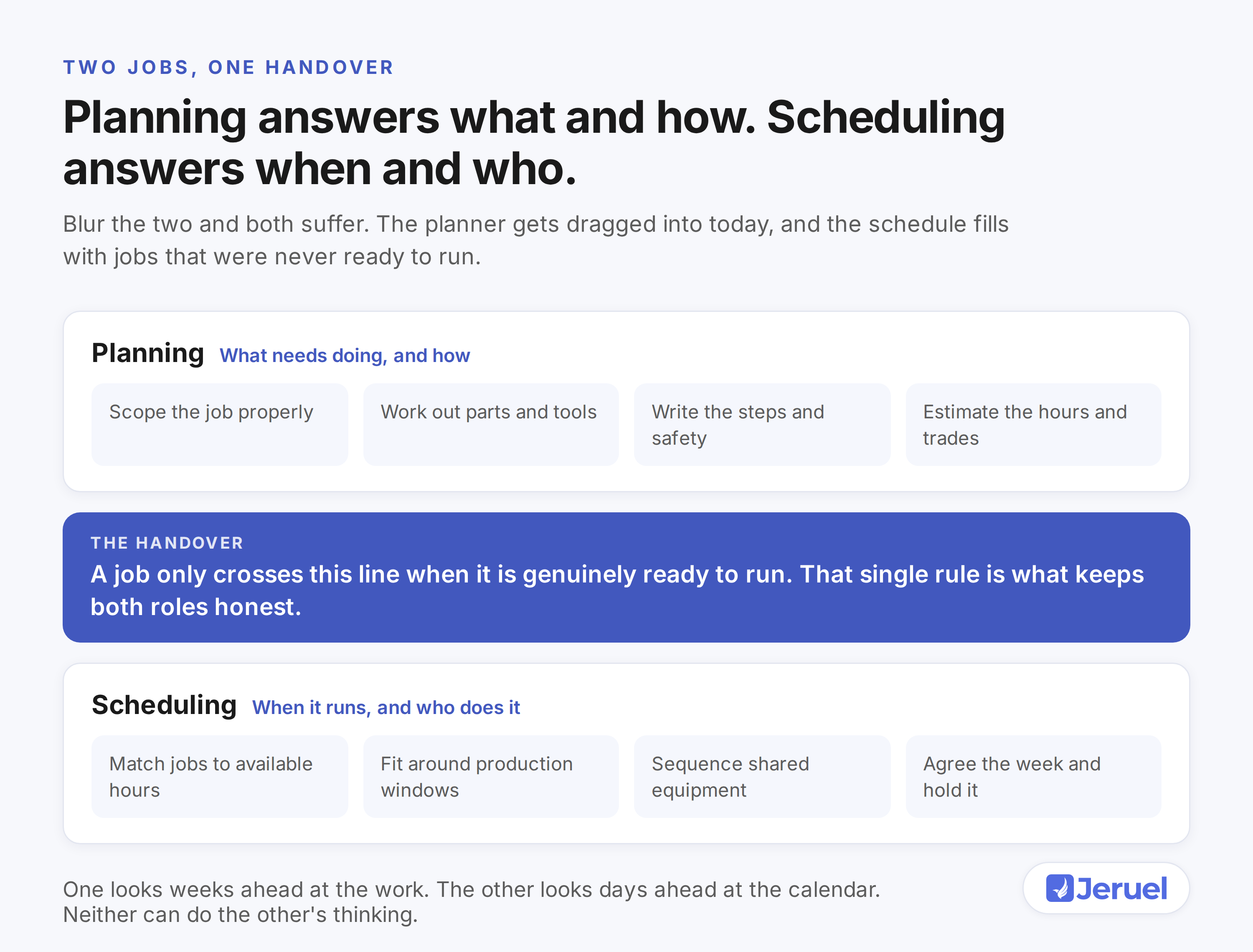
Planning looks weeks ahead at the work itself. What is wrong, what parts it needs, what steps and safety it involves, how many hours and which trades.
Scheduling looks days ahead at the calendar. What hours are available, what production will release, which jobs need the same crane, what fits this week.
Neither can do the other's thinking. And when the same person does both under pressure, scheduling always wins, because the schedule has a deadline and the planning does not.
The handover rule that fixes most of it
If you take one thing from this, take the rule about the line between them.
A job only moves from planning to scheduling when it is genuinely ready to run. Parts available or on a known date. Steps written. Access understood. Hours estimated.
Not ready means it stays in planning. It does not go on the schedule as a hopeful entry.
This sounds strict, and it is the whole point. The most common failure in maintenance scheduling is a week full of jobs that were never ready. They do not happen. Everyone learns that the schedule is fiction.
What goes wrong when they blur
Three things happen, and you can usually spot all three in a plant that has merged the roles.
The first is that planning stops. Today's schedule always feels more urgent than next month's preparation, so the preparation quietly disappears. Six weeks later the jobs being scheduled are unprepared, and they run badly.
The second is that schedule compliance stops meaning anything. Jobs scheduled before they are ready get bumped for good reasons. The number falls, and it is now measuring readiness rather than discipline.
The third is that nobody can say why the week went wrong. Was the job badly planned, or badly scheduled? With one person doing both, there is no way to separate the two, so the same problem repeats.
You do not need two people
Small plants often cannot justify a separate scheduler. They do not have to.
What matters is separating the two activities in time, not in headcount. One person can do both if the planning happens in protected hours that scheduling is not allowed to eat.
A practical version looks like this. Two mornings a week are planning. Nothing about this week's schedule is allowed in. One afternoon is scheduling, working only from jobs that are already ready. The rest of the week is everything else.
The separation is the point. Whether it lives in two people or two blocks of one person's calendar matters much less.
Where the backlog fits
Between the two roles sits something worth naming: the ready backlog.
This is the pile of jobs that have been planned and are waiting for a slot. It is not the same as your total backlog, which includes everything anyone has ever raised.
A healthy ready backlog is what makes scheduling easy. When production suddenly offers you four hours on Thursday, you want a stack of prepared jobs to pull from, not a scramble to get something ready in time.
Most plants aim for a few weeks of ready work. Less than that and the scheduler has nothing to work with. Much more and you are planning jobs that will sit so long the situation changes before they run.
The two conversations
Once the roles are separate, the meetings separate too, and both get shorter.
The planning conversation is with the technicians and the storeroom. What does this job actually involve, what did we find last time, what parts do we need. It is detailed and it happens well ahead.
The scheduling conversation is with operations. What can you release, what does that let us do, what are we committing to this week. It is short and it happens weekly.
Trying to have both in one meeting is why so many maintenance meetings run long and decide little.
How to start tomorrow
Pick your next week's schedule and mark each job as ready or not ready, using the handover rule.
Most plants find the not ready pile is bigger than expected. That number, on its own, usually settles the argument about whether the roles need separating.
Then run the following week with only ready jobs on it. The week will look emptier, which is uncomfortable. It will also be a week where what you said would happen actually happens, and that is worth more than a full schedule nobody believes.