Operations and Maintenance: How to Agree a Shutdown Window Without a Fight
The shutdown argument is not really about the machine. It is about two teams being measured over different lengths of time. Here is how to give both of them something they can read.

You need the line down for four hours. Operations says not this week. You say it has been not this week for a month. Everyone leaves the meeting slightly annoyed, and the job moves again.
If that exchange feels familiar, the useful thing to know is that it is not really a disagreement about the machine. It is a disagreement about time, and it has a shape you can work with.
Why both sides are right
Operations is measured on what comes off the line this month. Maintenance is measured on how the plant runs across the year. Those are both reasonable ways to run a business, and they point in opposite directions on a Tuesday afternoon.
From the operations chair, stopping the line is a cost you can see immediately. The failure you are warning about has not happened, and might not. From the maintenance chair, the risk is visible and growing, and the cost of ignoring it will land in a month nobody is looking at yet.
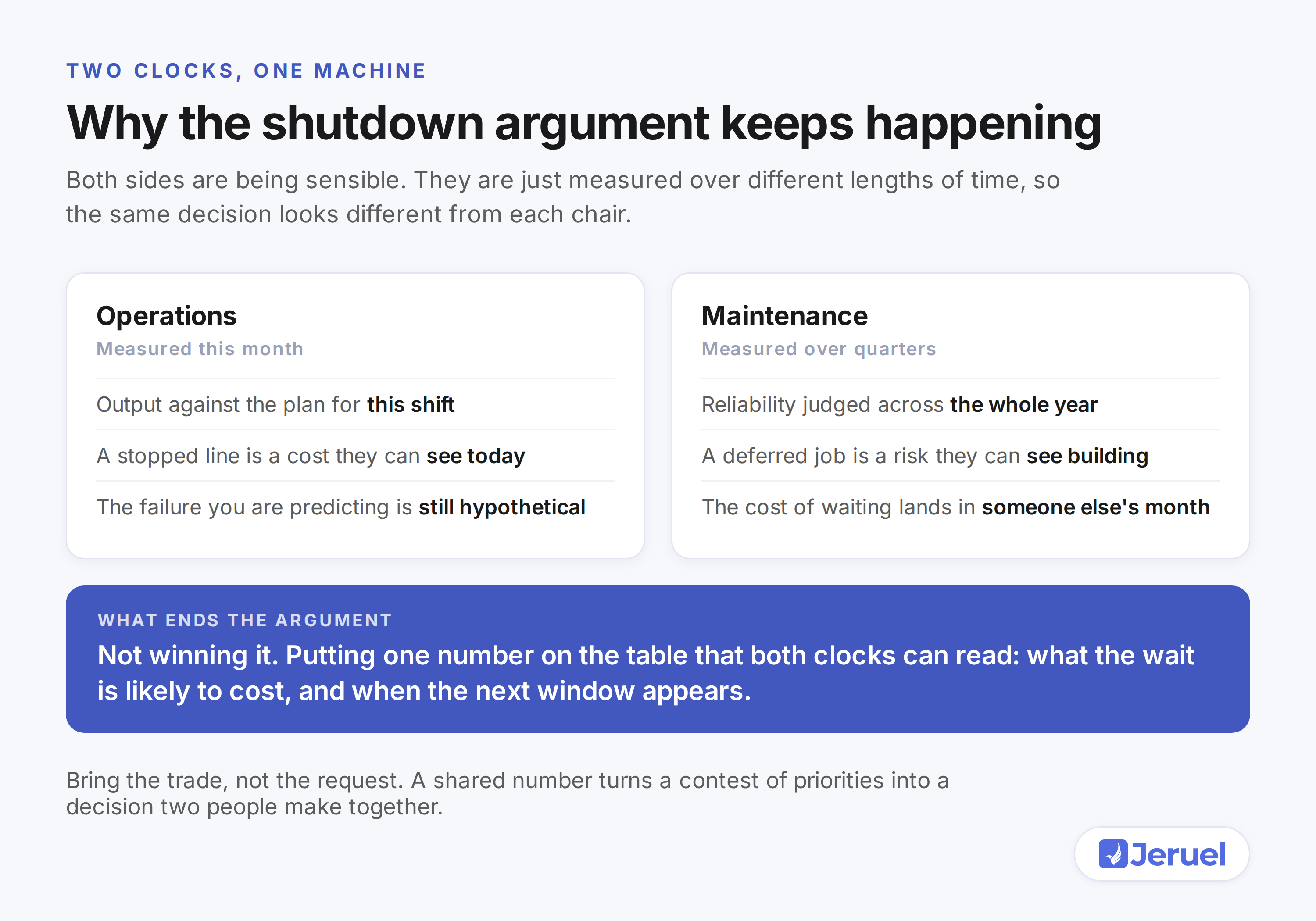
Neither person is being difficult. They are reading two different clocks. Once you see it that way, the goal stops being to win the argument and starts being to give both clocks something they can read.
Bring the trade, not the request
Most shutdown requests arrive as a request. We need four hours on number three.
That gives the other person nothing to work with except yes or no, and no is always the cheaper answer this month.
Bring the trade instead. That means three things, and none of them need to be precise to be useful.
What the wait is likely to cost. Not a guess dressed up as a fact, but an honest estimate. If this bearing goes, we are looking at a day and a half, not four hours, and the parts are three weeks out.
What you are asking for exactly. Four hours, two people, this specific job. Vagueness invites delay.
When the next realistic window is. If not this week, then when. That question turns a refusal into a booking.
Ask for the smallest thing that works
A request for a full day will be argued about. A request for two hours during an existing changeover often will not.
Before you ask, check what stoppages are already happening. Product changeovers, cleaning, shift handovers, a scheduled slow period. Work that fits inside a stop somebody else has already agreed to is much easier to say yes to, because it costs nothing new.
This is worth genuine effort. A lot of maintenance work can be split so that the part needing the line down is small, even when the whole job is long. Preparation, staging and rebuild can happen while the machine runs. Only the actual intervention needs the window.
Agree the rules when nothing is at stake
The worst time to decide how these calls get made is during the argument.
Sit down in a calm week with your operations counterpart and agree a few things in advance. What counts as urgent enough to stop the line today. How much notice you will give for planned work. What happens when the two of you cannot agree, and who decides then.
Write it on one page. Not a procedure, just a shared understanding you can both point at.
What this does is remove the personal edge. When there is an agreed rule, the conversation is about whether this situation meets it. When there is not, it is about who is more insistent, and that is a much worse way to run a plant.
Give them something in return
This part gets missed, and it changes the relationship more than any process.
Operations gives you windows. What do you give them? Finishing on time is the big one. If you ask for four hours and take seven, the next request is much harder, and rightly so. If you consistently hand the line back when you said you would, your requests start getting believed.
Telling them early is another. A window you flag three weeks out is far cheaper for them to plan around than the same window flagged on Monday.
And closing the loop matters. When the job is done, tell them what you found. We opened it up and the coupling was worse than expected. That one sentence does more for your next request than any argument, because it turns your prediction into evidence.
When they say no anyway
Sometimes the answer is genuinely no, and the reason is genuinely good. A customer order, a contract, a shutdown already booked.
When that happens, do two things.
Get the next window in writing, even if writing means an email. A vague later becomes never surprisingly quickly.
Then record the deferral and what you expect the consequence to be. Not as a way of building a case against anyone. As a record you can both look at later. Half the time nothing happens, and you learn something about your own risk judgement. The other half, something does happen, and the next conversation is much shorter.
The longer game
Plants where this works well are not the ones with better arguments. They are the ones where the two supervisors talk regularly when nothing is wrong.
If your only conversations with operations are requests to stop production, every conversation is a negotiation. If you are in their morning meeting, and they know what you are working on, it changes. The shutdown becomes one small item between two people who already understand each other's week.
That takes months, not one good meeting. It is also the difference between a plant that argues about every window and one that plans them together.