Overall equipment effectiveness: why a busy machine can still lose half its capacity
Walk the floor and Machine D looks like a hero. It is running, the operators are busy, the whole shift is a blur of motion. The board says the line was occupied all day, so surely it earned its keep.
Walk the floor and Machine D looks like a hero. It is running, the operators are busy, the whole shift is a blur of motion. The board says the line was occupied all day, so surely it earned its keep.
Then someone adds up what actually left the machine as good product, and the number lands like a cold splash of water: barely four of every ten units it was capable of making. Nothing was broken. No alarm sounded. The capacity simply leaked away, a few minutes here and a touch of lost speed there, in all the places nobody was watching.
That is the problem overall equipment effectiveness was built to solve. A busy line and a productive line are not the same thing, and OEE is how you tell them apart.
What it actually measures
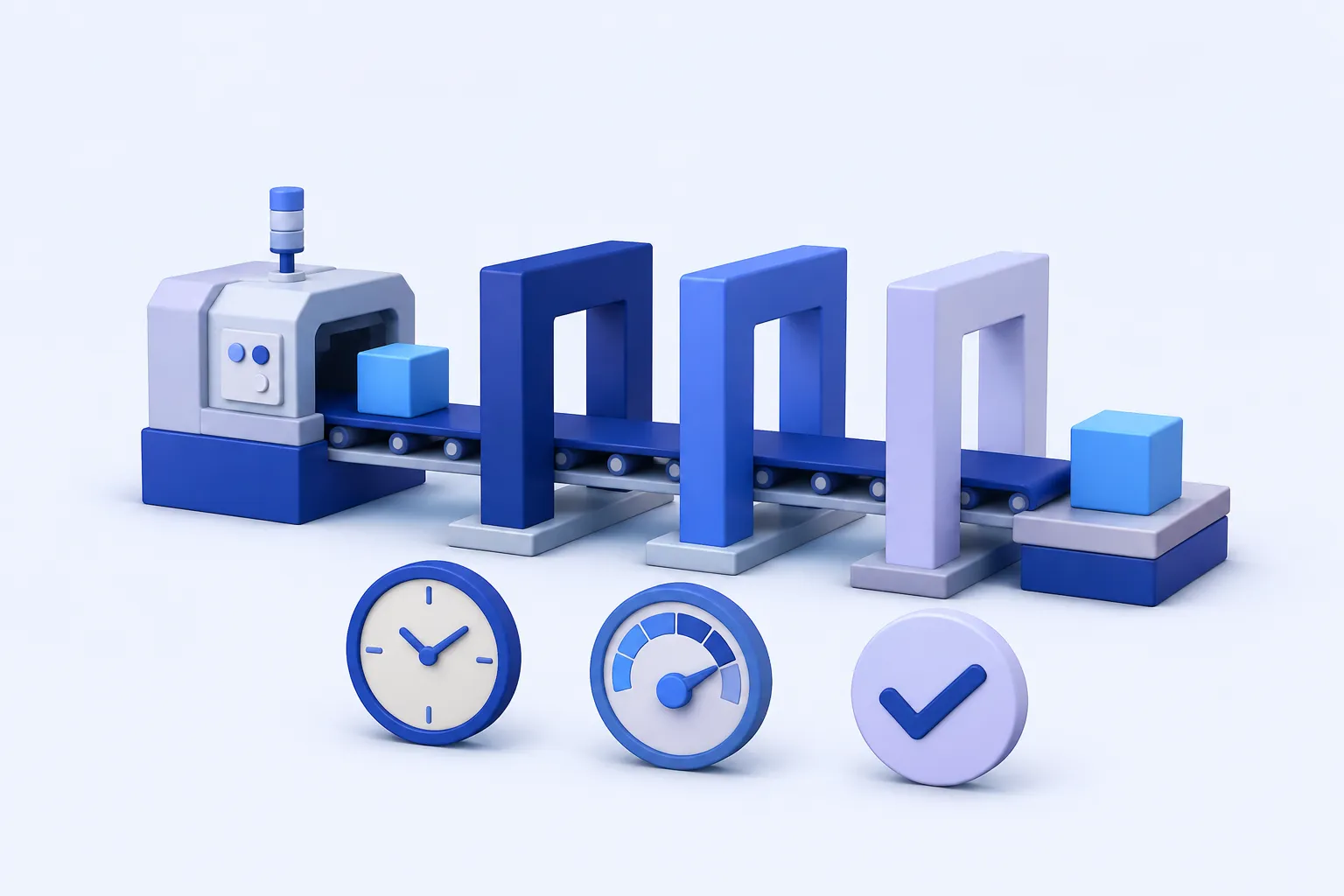
OEE rolls three honest questions into a single percentage:
- Availability. When the machine was scheduled to run, was it actually running?
- Performance. When it was running, did it run at full speed?
- Quality. Of everything it made, how much was good the first time?
Multiply the three together and you get one number, from 0 to 100 per cent, for how much of the machine's true potential you actually captured. The beauty of it is that the three answers also tell you where the loss lives, so you are never left guessing which problem to chase first.
Behind those three factors sit the six classic losses that drain a machine, and each one lands in a bucket. Two attack availability: outright breakdowns, and the time swallowed by setups and adjustments. Two attack performance: the small stops and idling too brief to log, and running below the rated speed. And two attack quality: defects and rework, and the scrap a line throws while it settles down after a start. Name the loss and you have already named the factor it is hurting.
How to work it out
OEE = Availability × Performance × Quality
Take that day on Machine D, factor by factor.
| Factor | The question it answers | Score |
|---|---|---|
| Availability | Was it running when scheduled? | 76.6% |
| Performance | When running, was it at full speed? | 59.9% |
| Quality | Was the output good first time? | 92.0% |
OEE = 76.6% × 59.9% × 92.0% = 42.2%
Forty-two units of every hundred it could have made. The line looked fully occupied, yet more than half its capacity quietly vanished, and notice exactly where it went: availability and quality are respectable, but speed is the weak link. That one insight tells the team precisely where to start, instead of arguing in the dark.
A number that punishes weak links
Because the three factors multiply rather than average, OEE is unforgiving in a way that catches people out the first time. Three respectable-looking factors of 90 per cent still come to only about 73. Knock each down to a passable 50 and the score collapses to 12.5. Even a machine that never stops, a perfect 100 per cent availability, lands at just 56 if it merely runs at 75 per cent speed and 75 per cent quality. That is the metric working as designed: it refuses to let a strong factor paper over a weak one, and it quietly insists you fix the worst number first.
What good looks like
The widely accepted mark of world-class is 85% or better, and it is reached only when all three factors are excellent at once, roughly availability above 90 per cent, performance above 95, and quality close to 99. Most lines that have never measured OEE assume they are doing well and discover they are sitting around 50 per cent, some a good deal lower. That is not the sign of a bad team. It is the hidden loss finally becoming visible.
And the prize for closing it is enormous. Take a real press modelled at a measured 24 per cent OEE: lift the same machine, with the same crew, to a world-class 85, and it makes more than three times the good parts, the equivalent of running three and a half of the old presses without buying one. That is what people mean by hidden capacity, and capacity recovered that way is typically worth many times more than anything you could wring out of cutting costs. There is even a safety dividend, with plants that raise their equipment effectiveness tending to see injury rates fall almost in step, because the same disorder that wrecks OEE is what gets people hurt.
Where it can mislead you
- Measure it on a single machine or line, never a whole plant. Averaged across a site it blurs into a number too vague to act on, and it hides the real constraint. In one telling case the process everyone assumed was the bottleneck was running at 98 per cent, while the true limiting factor sat elsewhere, quietly starved by unplanned downtime. Bottlenecks also shift from day to day, so only a machine-level view catches the one that actually bit this week.
- Mind the reference rate. Performance can never genuinely exceed 100 per cent; if it does, the best rate was set too low. And beware the opposite trick, a flattering score measured against an out-of-date rate. One plant proudly reported 98 per cent until someone noticed the figure was measured against a production rate set before a debottlenecking; against the rate the line could now hold, it was nearer 70, turning a 2 per cent "opportunity" into a 30 per cent one.
- It is not a maintenance scorecard. Most of what moves OEE, scheduling, materials, operating speed, sits outside the maintenance team's hands, so using it to judge technicians alone is unfair and misleading. The number only moves when operations, maintenance and engineering pull together.
How to lift it
The route up follows the losses. Find the factor dragging hardest, then the specific loss behind it, and attack that first; the multiplying maths means the weakest factor always offers the richest return. The deeper truth is that reliability lifts every factor at once. Stop the unplanned breakdowns and availability climbs; the line then holds its rate, so performance climbs; and the fitful starts and settle-downs that breed defects grow rarer, so quality climbs too. One improvement, three rewards.
A busy machine flatters everyone who walks past it. OEE is the number that refuses to be flattered. It takes the comfortable feeling that the line is working hard and replaces it with an honest account of how much of its real capacity you are keeping. That honesty, uncomfortable as it can be the first time you see it, is one of the most valuable things a production team can own.