Reactive Maintenance: How to Break the Firefighting Cycle One Week at a Time
Nine out of ten teams know what drives reliability. About one in four can consistently do it. Here is how to protect your first few hours of planned work when the week is already full.

Most maintenance teams already know that planned work beats breakdown work. Ask anyone on the crew and they will tell you so. That is not the problem.
The problem is that knowing it does not give you the hours to act on it. A recent survey of maintenance teams found something worth sitting with. Nine out of ten said they understand what drives reliability. Only about one in four felt they could consistently do it.
So this is not an article about why planned maintenance is better. You know that already. It is about how to get the first few hours of it, when your week is already full.
Why the cycle holds
It is worth seeing the loop clearly, because it explains why willpower alone never fixes it.
A machine fails. The job is urgent, so the crew is pulled off whatever they were doing. The planned jobs they were meant to do slide to next week. Those planned jobs were inspections and small corrections, so the faults they would have caught go unnoticed. A few weeks later, those faults become the next breakdown.
Each stage produces the next one. Nobody in the loop is making a bad decision. Sending the crew to the failed machine is the right call in that moment. That is exactly why the cycle is so hard to break from the inside.
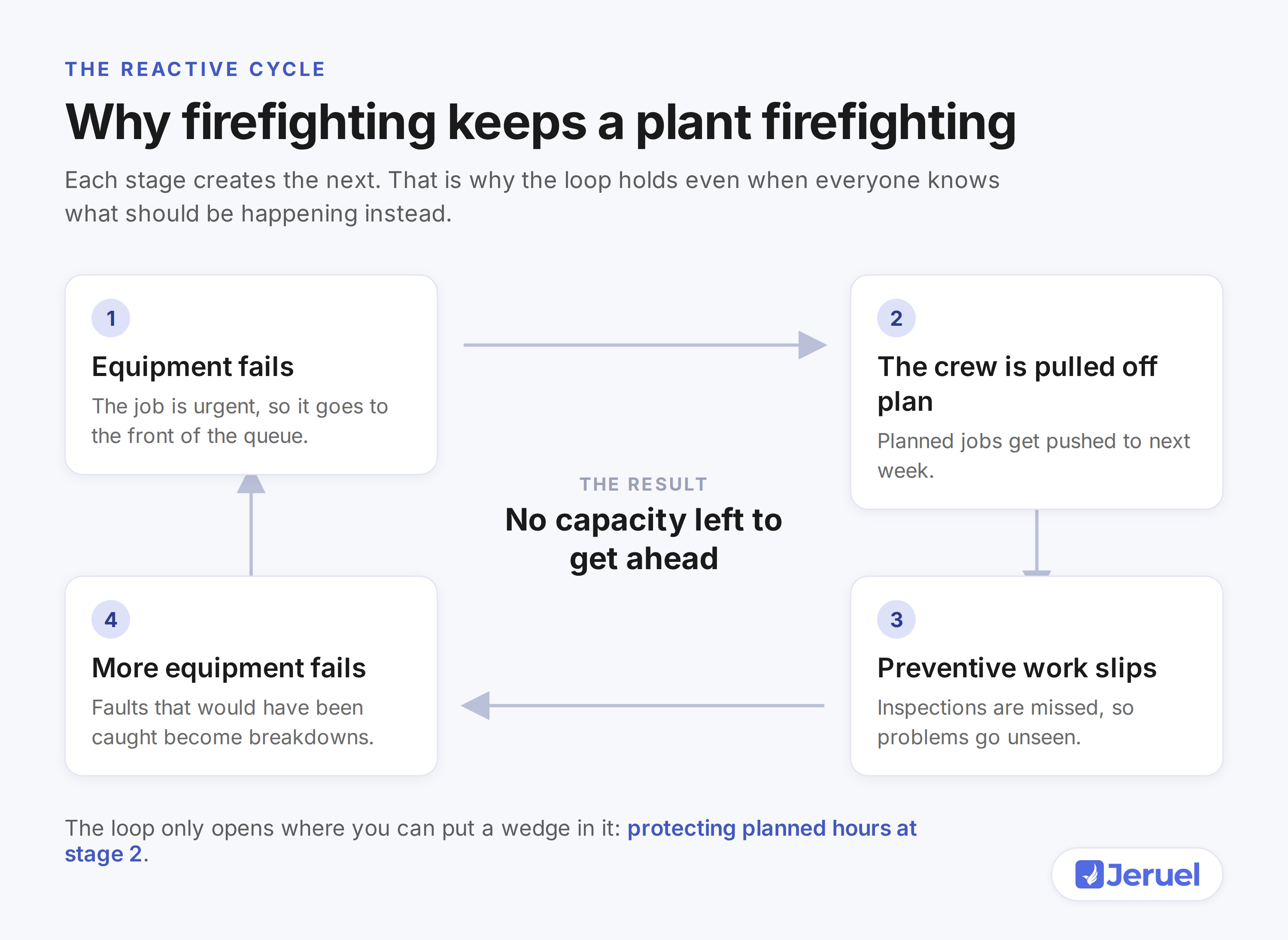
What this tells you is that the loop will not open at stage one. You cannot stop equipment failing today. It opens at stage two, at the moment the crew gets pulled off plan, because that is the only stage where you have a choice.
Start with hours you can actually defend
The instinct is to aim high. Someone announces that the plant will move to seventy per cent planned work. Two months later the target has quietly died, because nothing in the week changed to make room for it.
Try the opposite. Pick a number so small that you can protect it even in a bad week.
For most crews that is one technician, for one shift, once a week. That is it. Roughly eight hours out of several hundred.
It sounds too small to matter, and that feeling is the whole point. A target you can defend on your worst week is worth more than an ambitious one you abandon. You are not trying to transform the plant this month. You are trying to prove that protected hours are possible.
Decide in advance what breaks the protection
Here is where most attempts fall over. Nobody defines what counts as a real emergency, so everything becomes one.
Agree the rule before you need it, and agree it with operations rather than announcing it to them. Something like: this block gets interrupted for a safety issue, or for a failure that stops production. Nothing else waits for it to finish.
Then write down every time it does get interrupted, and why. That log matters more than the hours themselves.
After a couple of months you will be able to say something specific, like eleven interruptions, seven of them from the same two machines. That sentence is far more useful than a general complaint about firefighting, and it points straight at what to fix next.
Spend those hours where they buy the most time back
The temptation is to spend your first protected hours on whatever is loudest. Resist it. You have very few hours, so they need to earn more hours than they cost.
Two things usually pay back fastest.
The first is your worst repeat offender. Not the biggest machine, the most frequent one. Pick the asset that has failed most often in the last year and spend the time on the cause rather than the symptom. If you break the repeat, you get those emergency hours back permanently.
The second is preparation. Take the three jobs you know are coming and get them genuinely ready. Parts in a kit, tools identified, procedure checked, access agreed. A job that is ready runs in a fraction of the time of one that is not. Most of the delay in maintenance is waiting, not working.
Both choices have the same logic. Spend the scarce hours on something that returns hours, and the next block is easier to protect than the last.
Expect the first weeks to feel worse
Be honest with everyone, including yourself, about what this feels like at the start.
When you hold back a technician for planned work, the reactive queue does not shrink. It grows slightly, because you have fewer hands on it. For a few weeks it will look like the idea is making things worse, and someone will say so.
This is the point where most plants quietly give the hours back. Knowing the dip is coming is most of what gets you through it. It helps to say so out loud at the start, because a predicted difficulty is far easier to sit with than a surprise.
The turn usually comes when the first prevented failure happens. That moment is worth naming when it arrives. It is the evidence everyone was waiting for.
Measure two things, not ten
You do not need a dashboard for this. You need to know whether the wedge is holding.
Track the protected hours you actually completed, as a plain number each week. Twenty-six weeks of that number tells you whether the discipline is real.
Track your interruptions and their causes, from the log above. That tells you what is eating the hours and where to aim next.
Once those two are steady, the wider measures like schedule compliance and unplanned work become worth watching. Starting with them is putting the instrument before the engine.
Then widen it, slowly
When one shift a week has held for two months, go to two. When that holds, add a second technician.
Growing this way feels frustratingly slow, and it is the reason it survives. Each step is small enough that operations can live with it, and each step is funded by the hours the previous step gave back. That is the compounding that gets a plant out of the loop, and there is no version of it that skips the beginning.
The plants still firefighting after twenty years are not the ones that never tried. They are usually the ones that tried to jump straight to the finished state, could not hold it, and concluded the whole idea does not work here.
It does work. It just starts much smaller than anyone expects.