Reliability Programme Rollout: Why the First Six Months Feel Slower
Six months in, the team is working harder and the numbers look worse. Both are usually true, and neither means the programme is failing. Here is what is happening underneath.

Six months into a reliability programme, somebody in a meeting says what everyone has been thinking. We are working harder than we were before, and the numbers look worse.
They are usually right on both counts. And nothing has gone wrong.
This is the most predictable phase of this kind of work, and it catches out plants that were never told to expect it. Here is what is happening underneath.
You pay before you collect
Every kind of prevention has the same shape. The cost comes first and the benefit comes later, quietly.
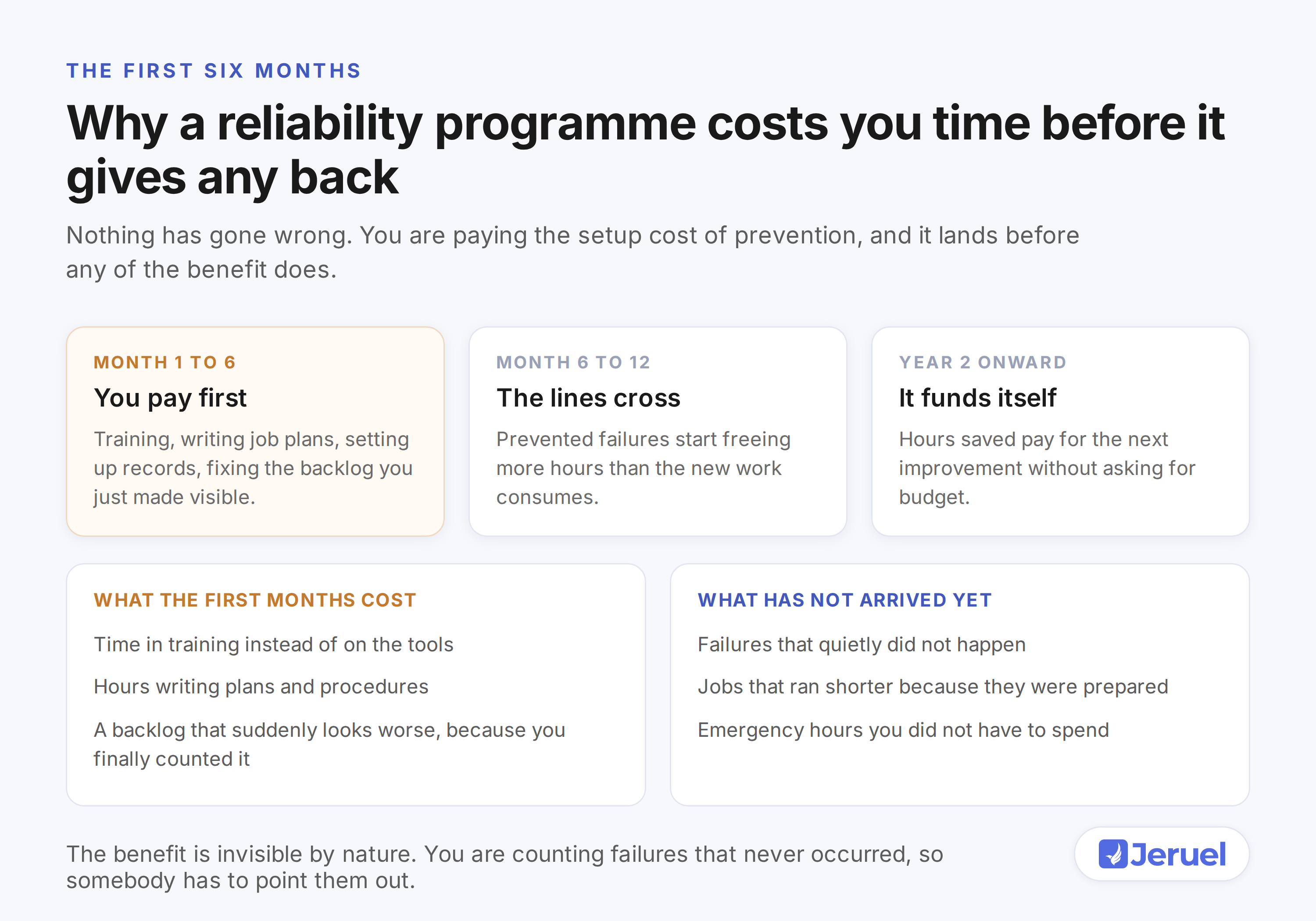
In the first months you are doing things that produce nothing yet. People are in training instead of on the tools. Somebody is writing job plans for work that has not been scheduled. Inspections are being set up. Records are being cleaned.
All of that is real work with a real cost. None of it has yet stopped a single failure, because the failures it prevents were going to happen later anyway.
Meanwhile the breakdowns keep coming, because the equipment does not know you have started a programme. So your crew is doing the old work and the new work at the same time. Of course it feels harder.
Why the numbers get worse before better
This part surprises people most, and it is worth understanding properly because it will be used against you.
When you start inspecting equipment properly, you find things. Faults that were always there, now written down. Your backlog grows, not because the plant got worse, but because you finally counted it.
The same thing happens with failure records. Insist that people record what actually failed and your failure count goes up. You did not create those failures. You made them visible.
Someone will look at that chart and conclude the programme is making things worse. Be ready for that conversation, and have the explanation ready before the chart appears rather than after.
The benefit is invisible by design
Here is the awkward part of prevention work. What you produce is absence.
The pump that did not fail does not appear anywhere. Nobody walks past it and notices it running. There is no event, no report, no moment where the value shows up on its own.
That means it has to be pointed out deliberately. When an inspection catches something, say so, in plain terms. We found the coupling wearing on number four, we changed it during the changeover, and it did not take the line down.
Say it in the morning meeting. Say it to the crew. This is not spin. It is describing something that genuinely happened and would otherwise leave no trace.
Measure the work while you wait for results
Between month one and month six, your outcome measures will not move much. If those are the only numbers you show, you look like you are achieving nothing.
So show the work too. Job plans written. Inspections completed on time. Failure records with a proper cause. Protected hours held.
These do not prove the programme is working. They do prove it is happening, which is what you need during the wait. Keep the outcome measures running underneath, and let them speak when they are ready.
What to tell your manager at the start
Have this conversation on day one, not in month five when you are being asked why nothing has improved.
Say three things plainly. The first six months will cost hours rather than save them. Some numbers will look worse before they look better, and here is exactly why. Here is what we will show you in the meantime so you can see it is on track.
A manager who was told this at the start will hold their nerve. A manager who was promised early results and did not get them will start asking whether this was the right decision, and they will be justified in asking.
When the lines cross
Somewhere between month six and month twelve, most plants notice a change.
The emergency calls thin out slightly. A job that used to take a day runs in half of one because the parts were staged. There is a week where nothing catches fire, and someone remarks on how quiet it has been.
That is the crossover. The hours you are getting back now exceed the hours the new work is costing you. From that point the programme starts paying for itself, and the next improvement is funded by the last one.
It is worth naming that moment out loud when it comes. People who worked through the hard patch deserve to know they were right to.
If you are in month four right now
The honest advice is to hold on and change as little as possible.
Check that you are doing the small number of things properly rather than many things partially. Check the protected hours are actually being protected. Then keep going.
The plants that give up here are not wrong about how it feels. They are just stopping a few months short of the point where the effort turns into time. That is a genuinely painful place to stop, because you have paid the entire cost and collected none of the return.