Repeat Equipment Failures: How to Find What the First Fix Missed
The same bearing goes for the third time this year. A failure that keeps coming back is telling you the first answer was incomplete, and it usually fails in one of four ways.
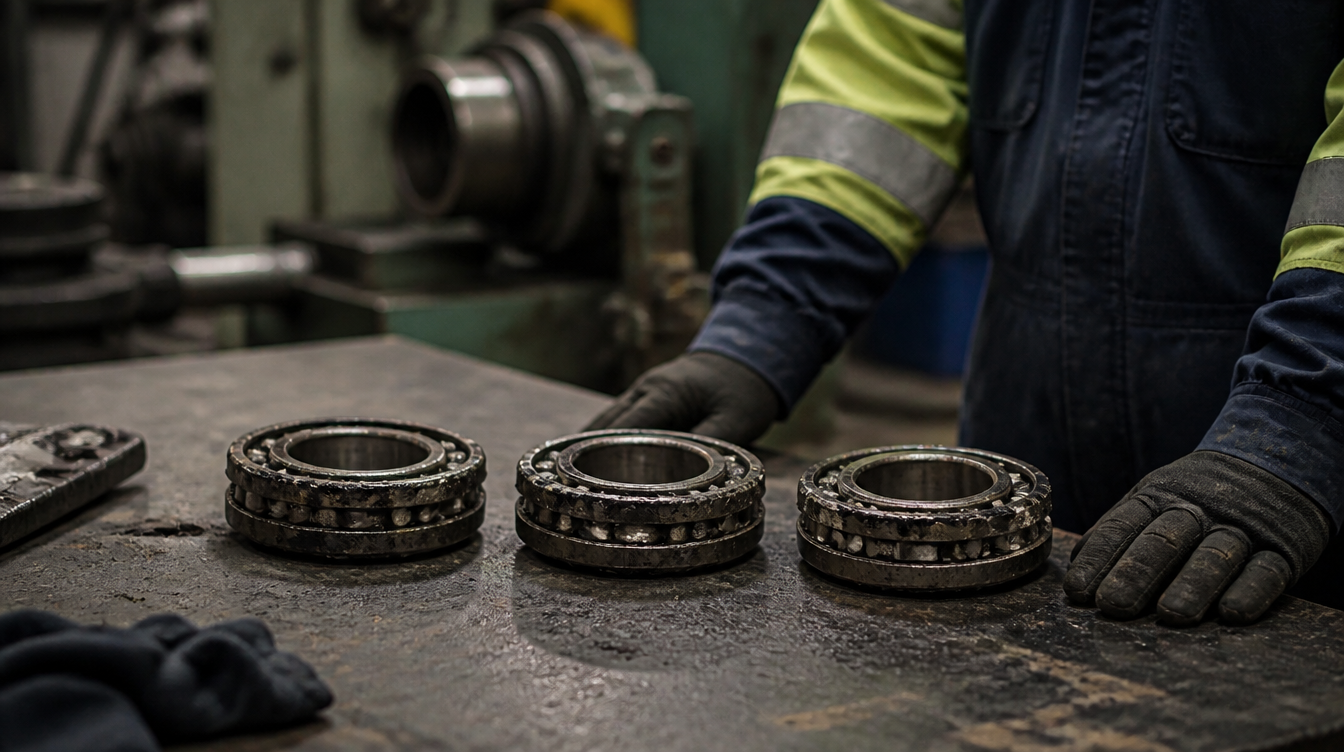
The same bearing goes for the third time this year. Somebody says that machine has always been trouble, a new bearing goes in, and the job closes.
That is a fair response to a busy morning. It is also the moment a repeat becomes permanent. Nobody asked why the last two fixes did not hold.
A failure that comes back is useful information. It tells you the first answer was not complete, and it narrows down where to look.
Four ways a fix fails to hold
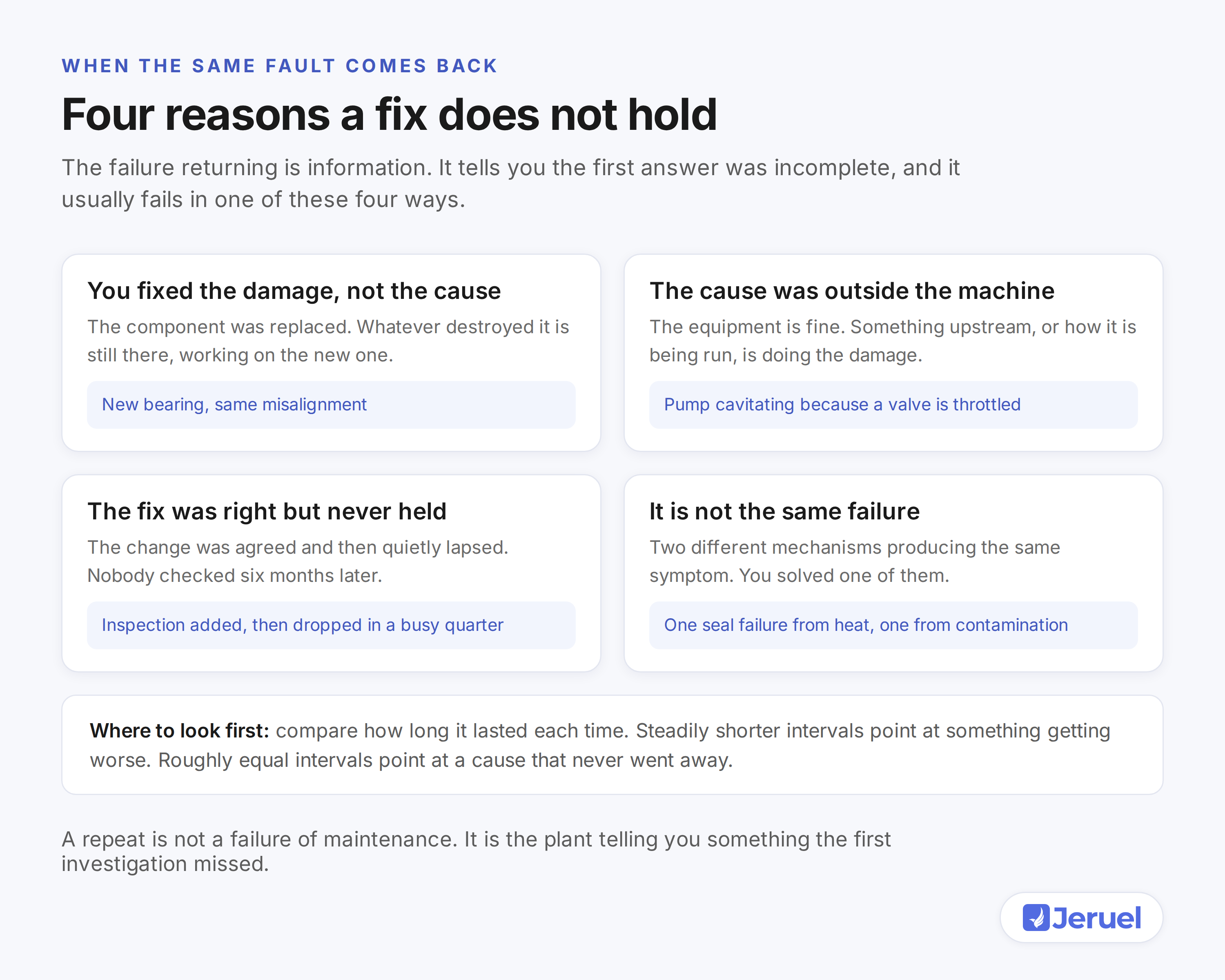
Almost every repeat fits one of those four. That is good news. You are choosing between four options rather than starting from nothing.
The first is the most common. A part gets replaced and whatever wrecked it is left in place, quietly working on the new one. The fix was a repair, not a cure.
Start with the intervals
Before you open anything, look at the dates. How long did the component last each time?
Roughly equal gaps suggest a steady cause. Something is doing the same damage at the same rate, and it has not changed. Look for a condition that is always there. Alignment, the wrong part for the duty, the way the machine is run.
Shorter and shorter gaps suggest something getting worse. Each failure leaves damage behind, or a nearby part is wearing out and taking the new one with it. Housings wear, shafts score, foundations work loose.
Uneven gaps often mean the cause is not in the machine at all. Look at what changes. Product runs, summer heat, a different operating mode, a particular shift.
That one comparison usually rules out half the options before you pick up a tool.
Look at the damage, not just the fault
When the component comes out, spend two minutes examining how it failed rather than confirming that it failed.
Bearings tell you a lot. Damage on one side points at misalignment or thrust. Even wear all round points at load or lubrication. Blue or brown colouring means heat. Fine pitting can mean electrical current passing through the bearing, which is a completely different problem with a completely different fix.
Seals, couplings and belts work the same way. The pattern of damage points at how it broke, and how it broke points at why.
This is why keeping the failed part until you have looked at it matters. Once it is in the skip, all you have is the fact that it failed.
Check whether the fix actually stayed
The third category catches plants out more than they expect.
An inspection was added after the last failure. A grease route was changed. An operating limit was agreed. Then a busy quarter arrived, the inspection got dropped, and nobody noticed because nothing failed for eight months.
So before assuming your fix was wrong, check whether it was still happening. Look at whether the inspection was completed, whether the route includes that machine, whether the limit is still in the procedure.
If it lapsed, you do not have a technical problem. You have a problem with things not sticking, and that needs a different fix.
Consider that it might not be the same failure
Two different mechanisms can produce the same symptom, and your records will show one repeated failure.
A seal that failed from heat and a seal that failed from contamination both appear as seal failure. If you solved the heat problem and the contamination problem was always there, the failure comes back and it looks like your fix did nothing.
This is where specific records pay off. If your history says seal faces overheated one time and grit got in the next, you can see straight away that you have two problems.
Widen the frame
If the intervals are irregular and the damage does not point anywhere obvious, stop looking at the machine.
Ask what feeds it, what it feeds, and how it is being run. A pump that keeps failing may be running away from its design point because a downstream valve is throttled. A gearbox may be seeing shock loads from a process upset nobody logs as a maintenance issue.
These are the hardest repeats to solve, because the evidence is not in your records at all. They usually get solved in a conversation with operations, not in a workshop.
Make the repeat visible
One practical habit is worth adopting.
When a job is raised on an asset that failed the same way within the year, flag it as a repeat before the work starts. Not afterwards.
That flag changes what happens. It tells the technician to keep the part and look at it. It tells the planner this is not a routine replacement. It means somebody asks the question while the evidence is still on the bench.
Without it, the third failure gets handled exactly like the first, and the plant learns nothing on either occasion.