Shutdown and Turnaround Planning: What to Do Twelve Months Out
Turnarounds rarely fail during the turnaround. They fail months earlier, in a meeting where somebody said we will sort that out nearer the time.
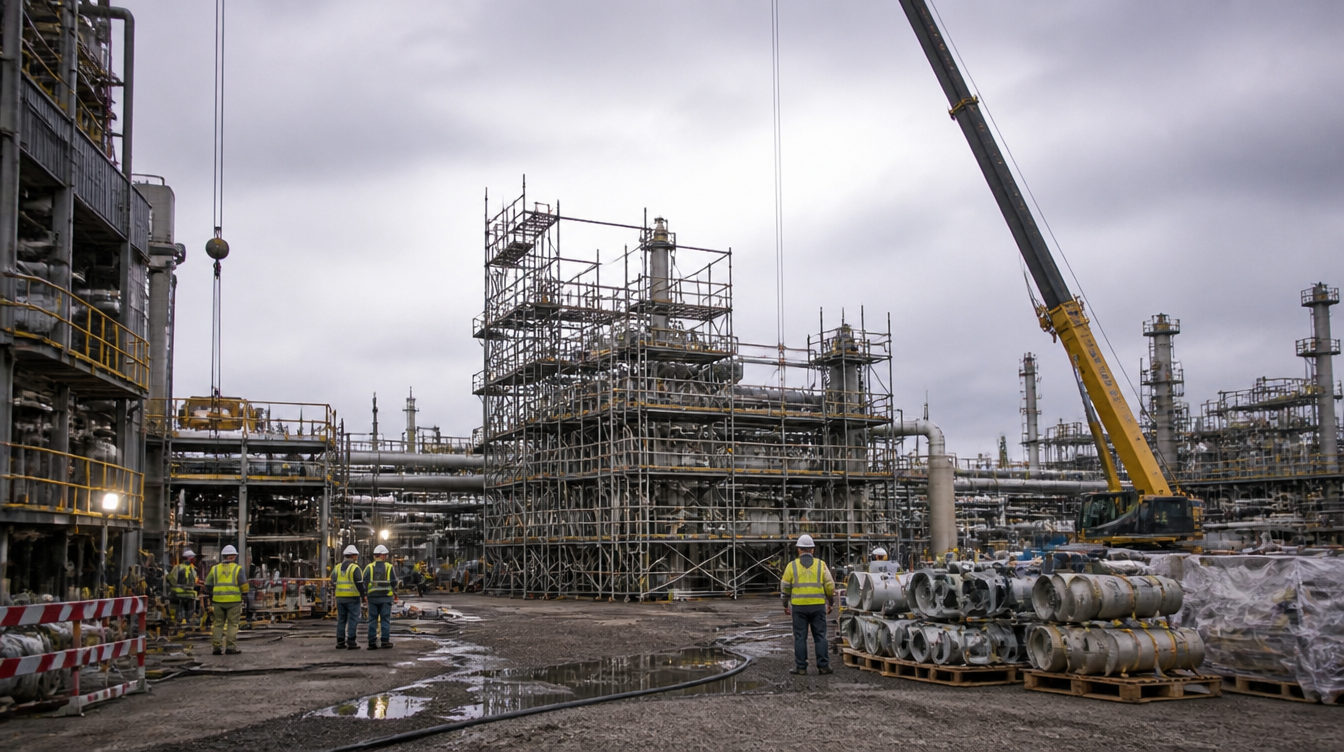
Turnarounds rarely fail during the turnaround. They fail months earlier, in a meeting where somebody said we will sort that out nearer the time.
The execution is the visible part, so that is where the attention goes. But by the time the window opens, most of the outcome has already been decided.
Here is what the year before actually looks like.
Working backwards from the window
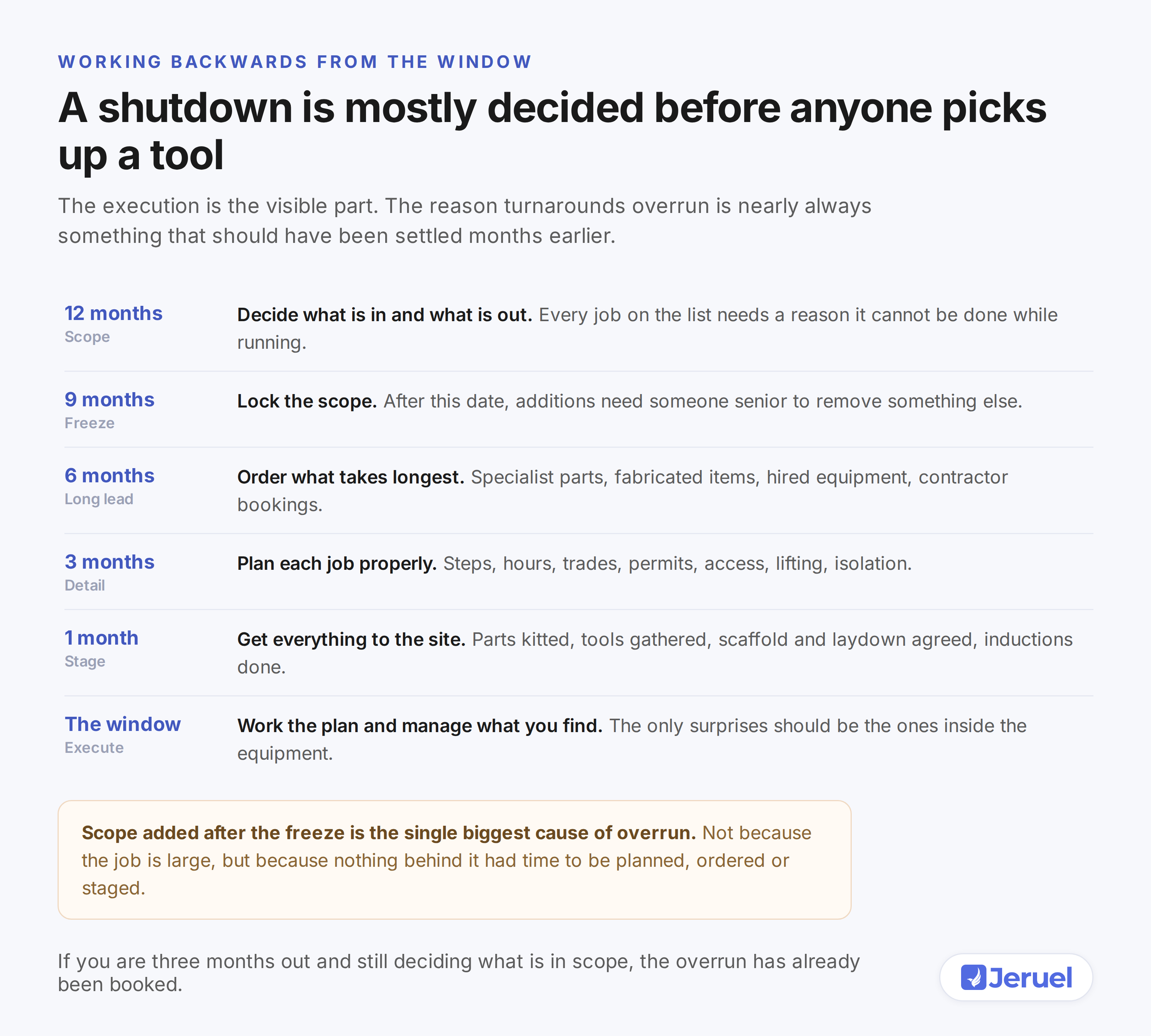
The dates are not sacred. A smaller shutdown might compress this into six months, a major one might need eighteen. What matters is the order, because each step depends on the one before it.
You cannot order long lead parts until you know the scope. You cannot plan the jobs until you know what you are buying. You cannot stage anything until the jobs are planned.
Skip a step and it does not disappear. It reappears during the window, when it is expensive.
Start by challenging the scope
Every job on a shutdown list should pass one test. Why can this not be done while the plant is running?
Ask it seriously and a surprising number of jobs fail. They ended up on the list because a shutdown is convenient, not because they need one. Each of those is consuming window time that a genuine shutdown job needs.
The jobs that survive the test are the ones that need the equipment stopped, opened, isolated or emptied. That is your real scope.
This is also the cheapest hour you will spend on the whole turnaround. Removing a job at twelve months costs nothing. Removing it during the window costs a crew standing around.
The freeze is the discipline that matters
Pick a date after which the scope is closed. Then defend it.
Defending it does not mean refusing everything. It means anything added has to displace something, and that decision goes to someone senior enough to own the consequence.
The reason this matters so much is that late scope has no tail behind it. A job added at two months has no parts ordered, no plan written, no contractor booked, no permit prepared. It arrives in the window as an unplanned job, which is the most expensive kind of work there is.
When a turnaround overruns, this is usually why. Not because the planned work was underestimated, but because the unplanned additions had nothing behind them.
Plan for what you will find
Some discovery is unavoidable. You open a vessel and it is worse than expected. That is the nature of the work.
What separates plants that cope from plants that do not is whether they planned for discovery at all.
Two things help. Leave a genuine allowance in the schedule, usually a meaningful share of the total hours, rather than pretending everything will go to plan. And decide in advance who can authorise extra work in the window, and up to what limit.
That second one saves hours. Without it, every discovery triggers a hunt for whoever can approve it, while a crew waits.
The parts problem hides until it is too late
Long lead items are the most common cause of a job being pulled at the last minute.
At six months, go through every planned job and mark what has to be bought. Then check the actual lead times rather than the ones in the system, because those two are often different.
Anything longer than the time remaining is a decision you need to make now. Order it, find an alternative, or take the job out of scope. All three are fine. Discovering it at three weeks is not.
Contractors need the same lead time as parts
Specialist contractors get booked well ahead, and the good ones get booked first.
Beyond booking, the thing that decides how well contractors perform is how well they were briefed. A contractor who arrives knowing the scope, the site rules, the access and the isolation arrangements starts working on day one. One who arrives cold spends a day and a half finding out.
Send the information early. Do the inductions before the window, not during it.
Stage everything before it starts
In the last month, the job is logistics.
Parts kitted by job rather than sitting in stores. Tools gathered and checked. Scaffold up. Laydown areas agreed. Lifting arranged. Permits drafted. Inductions done.
The measure of a well staged turnaround is that on the first morning, every crew can start without looking for anything. That sounds obvious and it is rare, and it is worth more than almost any efficiency gained during the work.
Write down what happened
In the week after, while it is fresh, spend two hours capturing what went wrong and why.
Which jobs took longer than planned. What you found that you had not expected. Which parts were wrong. Where the plan was optimistic.
Almost nobody does this, and it is why the same problems appear next time. Two hours of honest notes is the cheapest improvement available to the next turnaround, and the only version of it that survives the people involved moving on.