Vendor managed inventory: handing the routine restocking to your suppliers
A storeroom clerk spends half her week reordering nuts, bolts, cable ties and lubricants. She counts them, raises purchase orders, chases deliveries and puts them away. Every hour on that is an hour not spent cycle-counting, rationalising duplicat...
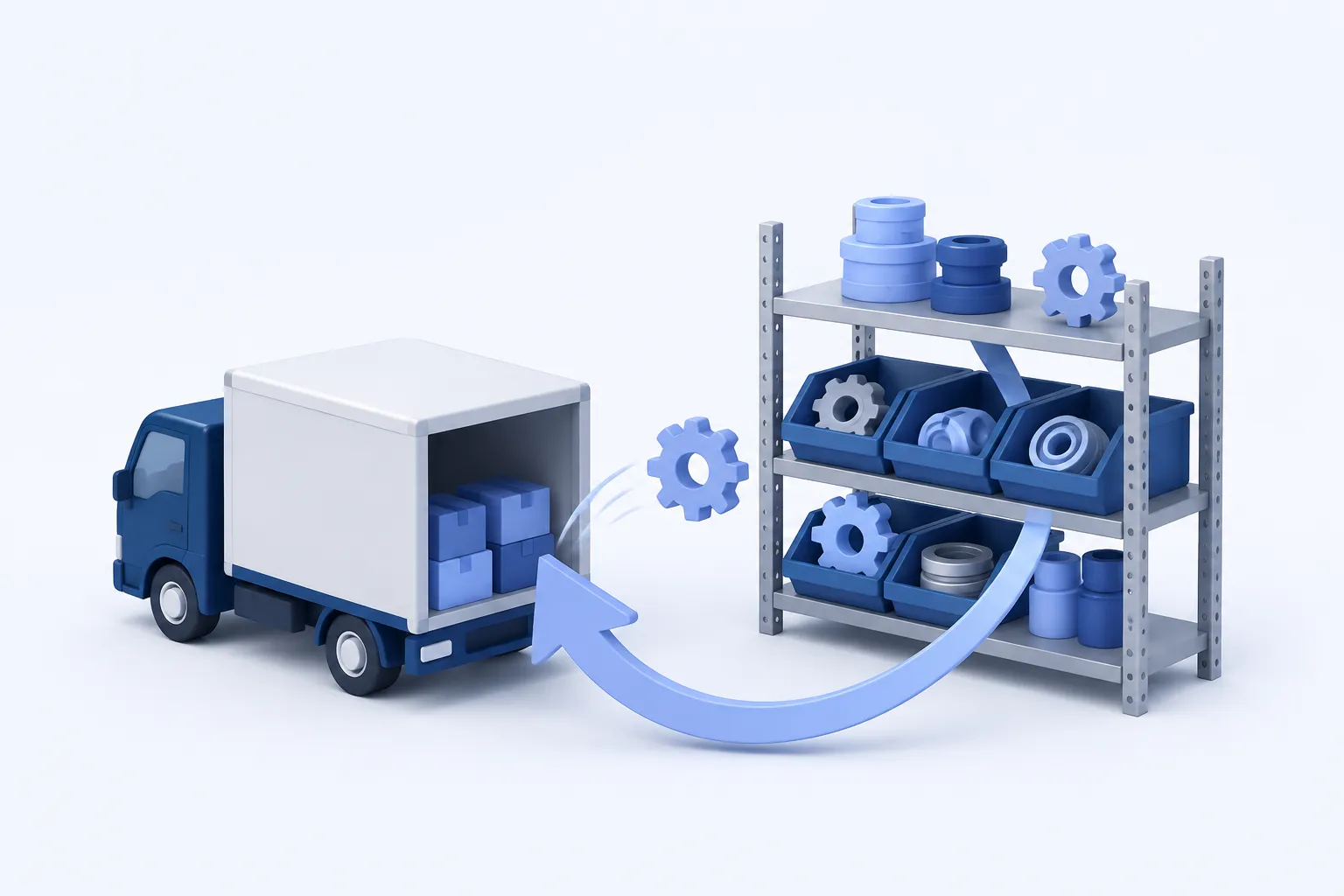
A storeroom clerk spends half her week reordering nuts, bolts, cable ties and lubricants. She counts them, raises purchase orders, chases deliveries and puts them away. Every hour on that is an hour not spent cycle-counting, rationalising duplicates, or looking after the high-value critical spares that genuinely need her judgement.
Vendor managed inventory shifts that burden. The supplier keeps the low-value, high-turnover items stocked on your shelves, owns them until you pull one, and replenishes without you raising a single order. Your team is freed for the work that actually requires thought.
What it actually measures
Vendor managed inventory is the proportion of your MRO stock that a supplier owns and replenishes rather than your own team. It is usually expressed either as a ratio of vendor-managed items to total stocked items, or as a percentage of total inventory value. Both are valid; just pick one and use it consistently when you compare sites.
How to work it out
Vendor managed inventory (%) = (Vendor-managed stocked items × 100) / Total stocked items
Plant A manages 4,960 items directly and has 240 managed by a vendor, for 5,200 in total:
Vendor managed inventory = (240 × 100) / 5,200 = 4.6% of items
By value, those vendor-managed items are worth just $24,000 against a total stocked value of about $1,950,000, which works out to 1.2%. The two figures tell different stories: the items are many but individually cheap, exactly the profile that suits vendor management.
What it frees you to do
The real point of vendor management is not the percentage itself but the decision behind it: working out what you should not be stocking and reordering yourself at all. The cheap, fast-moving, predictable consumables are pure administrative drag, the kind of items whose reorder paperwork costs more than the parts. Handing those to a supplier on a consignment or automatic-replenishment arrangement frees your storeroom team to spend their judgement where it counts, on the expensive, critical, judgement-heavy spares that should never be on autopilot. Used well, the metric is really a gauge of how cleanly you have separated the routine from the consequential.
There is a second benefit that shows up on the balance sheet rather than in the storeroom. Under most vendor-managed arrangements the supplier owns the stock until the moment you draw it down, which means those items sit on your shelves without sitting on your books. The working capital they would otherwise tie up stays free, and the carrying risk of obsolescence shifts to the vendor, who is far better placed to redistribute a slow-moving item across other customers than you are to write it off.
What good looks like
No widely agreed target has been set. Use the metric to track how your programme grows and to compare your own sites. Vendor management tends to work best for low-value, high-volume consumables, where handing off the routine reordering frees real storeroom capacity without taking on much supply risk. It is the wrong tool for the critical spares, where the consequences of a replenishment failure are too high to delegate.
Where it can mislead you
- When comparing plants, be clear whether you are measuring by item count or by value. The two tell different stories and must never be mixed.
- Each vendor-managed item needs its own unique record so it can be counted and tracked properly.
- A high vendor-managed share concentrates supply risk in a few suppliers, so review your contingency arrangements regularly.
- Plants without good transaction history may have to use invoice values as a proxy for on-hand value, which adds some imprecision; note it when you do.
Vendor managed inventory measures how much of the routine restocking grind you have handed to suppliers. Grown thoughtfully, it is one of the simplest ways to free a storeroom team from low-value reordering and point them at the spares, the data and the rationalisation that actually move the needle.